From a Japanese children’s game to a global collectibles market worth billions, Pokémon cards have become an unlikely alternative asset class. But behind the rare cards, eye-watering prices and speculative frenzy lies something more interesting: a world of collectors, gamblers, nostalgia and surprisingly expensive pieces of cardboard.
There is something faintly ridiculous about walking into an unremarkable office tower in Chatswood, getting buzzed in, climbing several fights of diminish lit stairs and discovering a Pokémon trading card business Rice Collects operating out of what was once a small beige office.
No elaborate retail fit-out. No enormous Pikachu suspended from the ceiling. Just a couple of rooms, some display cabinets, a few posters, some low key merch, two staff and a large collection of little pieces of cardboard, some worth more than a reasonable second-hand car.
I had gone along with my son, now in his late teens, who wanted to swap a Pokémon card. Later we met up with my daughter, who is in her twenties, and visited a second similar shop. What I discovered was a fascinating little economy that has evolved considerably since Pokémon first appeared in the 1990s.
Indeed, having visited two such establishments tucked away in otherwise ordinary Chatswood office buildings, I came away thinking that Pokémon collecting had become something of a cross between stamp collecting, the art market and a visit to the pokies at the local RSL.
And, rather unexpectedly, I enjoyed the experience.
From a Japanese video game to a global phenomenon
Pokémon began in Japan in 1996 with the release of Pocket Monsters Red and Green for Nintendo’s Game Boy. The creation of Satoshi Tajiri, the concept was inspired partly by his childhood enthusiasm for collecting insects.
The premise was simple enough. Players travelled through a fictional world capturing, training and trading strange little creatures. The English slogan, Gotta Catch ‘Em All, neatly captured the collecting instinct that would eventually underpin an enormous commercial empire.
The Pokémon Trading Card Game followed in Japan in October 1996, initially published by Media Factory. The English-language game arrived in January 1999, with Wizards of the Coast, the company behind Magic: The Gathering, handling its early international distribution. The first English Base Set contained 102 cards, including the now-famous Charizard, Blastoise and Venusaur.
At the time, these were primarily children’s playing cards. They were swapped in school playgrounds, stuffed into pockets, held together with rubber bands and generally treated in a manner that would horrify today’s serious collectors.
That casual treatment has become an important part of their modern value. A first-edition holographic Charizard from 1999, for example, can command a remarkable price in near-perfect condition. Yet the same card, scratched, bent or heavily handled, might be worth a fraction of that amount.
The difference is not simply rarity. It is rarity combined with condition, print placement, artistic desirability and, ultimately, the willingness of somebody else to pay. Which, when you think about it, is how much of the collectibles market works.
The releases that shaped the market
Over three decades, Pokémon has released thousands of cards across numerous expansions, special editions, promotional campaigns and regional variations. Some releases are particularly important to collectors.
| Era | Major releases | Why collectors care |
|---|---|---|
| 1996–1999 | Japanese original sets, English Base Set, Jungle and Fossil | The original cards, first editions and early holographics |
| 2000–2002 | Team Rocket, Gym Heroes, Gym Challenge, Neo Genesis and Neo Destiny | Dark Pokémon, Gym Leaders, Shining Pokémon and the first Generation II characters |
| 2003–2007 | EX Ruby & Sapphire through EX Power Keepers | Pokémon-ex cards, Gold Star rarities and relatively scarce high-grade examples |
| 2007–2010 | Diamond & Pearl, Platinum and HeartGold & SoulSilver | LV.X cards, special artwork and the popular LEGEND cards |
| 2011–2016 | Black & White and XY | Full-art cards, EX cards and the introduction of Mega Evolution |
| 2016–2019 | Sun & Moon, including Team Up and Hidden Fates | Rainbow rares, Tag Team cards and highly desirable shiny Pokémon |
| 2020–2023 | Sword & Shield, including Evolving Skies and Crown Zenith | Alternate-art cards and enormous renewed collector interest |
| 2023–2026 | Scarlet & Violet (including Pokémon 151 and Prismatic Evolutions), followed by the Mega Evolution series from 2025 | Illustration rares, nostalgia-driven collecting, the return of Mega Evolution and continuing demand for premium artwork |
The original Base Set remains the obvious starting point for historical significance. However, age alone does not determine value. Some relatively recent cards have attracted remarkable prices because of their artwork, limited availability or popularity with collectors.
Evolving Skies, released in 2021, became particularly desirable because of its alternate-art Pokémon, including the Umbreon VMAX commonly nicknamed Moonbreon. The 2023 Pokémon 151 release, meanwhile, returned to the original 151 creatures, appealing directly to adults who remembered the game from childhood.
That nostalgia is a powerful commercial force. A generation that once traded Pokémon cards in the playground now has disposable income, jobs and, in some cases, a willingness to spend thousands of dollars recovering a small part of its childhood.
But there is another important factor: Pokémon regularly refreshes the market. New games, television series, films, anniversaries, special editions and card expansions all generate fresh interest. A previously overlooked character can suddenly become fashionable again, while a new illustration can make an otherwise ordinary Pokémon highly sought after.
Unlike antique books, where the supply of a particular first edition is permanently fixed, Pokémon is a living commercial franchise constantly introducing new things to collect. That makes it both interesting and potentially dangerous from an investment perspective.
When Pikachu met Mario
One of the more interesting corners of Pokémon collecting involves special collaborations and promotional cards. In 2016, Nintendo and The Pokémon Company produced a series of Japanese promotional cards featuring Pikachu dressed as Mario and Luigi.
The cards were sold in special boxes through Pokémon Center stores in Japan, originally priced at just ¥1,500 each. There were four promotional cards: two Mario Pikachu and two Luigi Pikachu designs, including full-art versions. They were never officially released in English.
Today, pristine graded examples can sell for thousands of dollars, with the most desirable full-art versions commanding more. Their appeal is fairly obvious. They combine two globally recognised Nintendo characters, distinctive artwork and a release that cannot simply be repeated in its original form.
Other collaborations and special releases have involved artists, fashion brands, museums and regional Pokémon Centers. The Van Gogh Museum collaboration in 2023, featuring Pikachu wearing a grey felt hat, is another example of how a promotional card can become a collector’s item almost overnight.
However, limited availability does not automatically mean a good investment. A card’s future value depends on continuing demand, the number of surviving copies and how many other collectors decide to preserve theirs in perfect condition.
Japanese, English and Chinese cards: Does language matter?
After my son had completed his swap at the first shop, we met up with my daughter, who was coming straight from work, and headed to a second Chatswood establishment, Papa Chonk TCG. Its entire range is Chinese-language cards, mostly Pokémon, with some One Piece, and it describes itself as a supplier and distributor as well as a retailer.
Like the first shop, it occupied a converted office, this time on the sixth floor of another thoroughly ordinary building. It only opened after 6 pm, which seemed an unusual business model until I considered that many of its customers, my daughter included, had day jobs.
The woman running the store was particularly helpful in explaining the differences between Chinese, Japanese and English releases.
Chinese cards are released and distributed separately, with their own product line-ups, packaging and, in some cases, exclusive artwork. She also thought some of the Chinese designs were better. I could see her point. Although the underlying Pokémon characters remain the same, the presentation can differ considerably between markets.
| Feature | Japanese | English | Chinese |
|---|---|---|---|
| Market | Japan | International English-language markets | Mainland China and traditional-Chinese markets, with distinct releases |
| History | Original TCG market, 1996 | First major English release, 1999 | Traditional Chinese releases preceded the mainland simplified-Chinese launch in 2022 |
| Artwork | Often receives new artwork first | Frequently uses Japanese artwork in differently configured sets | Can include distinctive regional products and exclusive cards |
| Collector appeal | Original releases, promos, print quality | Large international resale audience | Regional exclusives, artwork and growing collector interest |
| Pricing | Strong demand for premium Japanese cards | Broad pricing and resale infrastructure | More variable, depending on the card and market |
One should not assume that a Japanese card is automatically worth more than an English version, or that Chinese cards are necessarily cheaper. The precise card, release, condition and collector demand matter far more. And that brings me to my daughter.
For somebody buying purely for the artwork, however, the language may be almost irrelevant. Indeed, Chinese or Japanese lettering can be part of the aesthetic appeal.
Collecting the artwork rather than the collection
Having come straight from work, my daughter browsed a number of long boxes of Pokémon singles, each packed with rows of cards for customers to flip through. Collectors often call these containers bulk boxes. Bulk cards are Pokémon cards with little individual resale value. They’re often the commons and uncommons that pile up when collectors open booster packs. A collector might keep one copy for their set and sell the extras together as bulk, often by the hundred or thousand.
Interestingly, she wasn’t trying to complete a particular set, nor was she especially concerned about the potential resale value. She simply likes a certain style and a little wear is usually fine. Some cards feature elaborate backgrounds, unusual compositions, rich colours or a particular artistic style. Others are relatively plain. She was selecting the cards that appealed to her visually, much as somebody might buy small prints or illustrations. Also, a friend of hers had a favourite character, which upon discovery, led to the purchase of yet another card.
FUN FACT: In Pokémon card collecting, a master set typically includes one of every numbered card in a particular expansion, plus every version you can pull from its booster packs. That includes secret rares, which are numbered beyond the set’s printed total, and different finishes, so a regular card and its shiny “reverse holo” version each get a spot in the binder.
The Pokémon universe contains hundreds of characters and a remarkable variety of artwork. Collecting a complete modern set can become expensive, particularly when rare variations and promotional cards are included. But collecting cards because you like looking at them removes much of that pressure.
There is no obligation to own every card, no missing number in a binder demanding to be filled, and no need to pay an absurd premium simply because a particular card happens to be rare.
Both my children collected Pokémon cards when they were younger. Last year, they rediscovered their old collections and spent some time going through them. Two cards, in particular, might have been worth a reasonable amount of money had they been properly preserved.
Unfortunately, like most children’s possessions, they had been handled, shuffled and stored without much consideration for their future investment potential. A few scratches and damaged corners can make an enormous difference.
There is a lesson there for anybody who has children collecting cards today. Even if the cards are worth only a few dollars, it is worth protecting them. After all, nobody buying a Charizard in 1999 knew what somebody might be prepared to pay for one 25 years later.
The curious psychology of opening a pack
While my daughter examined the display cabinets, another customer sat at a small table in the middle of the shop. He had purchased eight packs of cards and was opening them one by one.
He wasn’t particularly interested in the ordinary cards. He was searching for highly desirable, colourful, holographic examples that some collectors refer to as chase cards. Indeed, he handed all his unwanted bulk cards to the woman running the store.
I watched for a while and couldn’t help thinking that it was a lot like watching somebody playing the pokies. There was the initial purchase, the anticipation, the reveal and the possibility of discovering something worth considerably more than the price of admission.
We got into conversation and he was more than willing to discuss his little hobby. Initially he spoke about the cards almost like it was an investment. But when pressed he admitted that he rarely sold. I asked him whether it was a little like gambling. He seemed slightly sheepish but acknowledged that it was. He also mentioned that he did livestreams involving the cards.
What I found particularly interesting was that he didn’t really sell his collection. He simply kept buying more. That makes him a collector rather than a conventional investor, although the excitement of acquiring something valuable was clearly part of the attraction. The live stream, a way of communicating that passion.
The woman running the shop explained that the business had converted the neighbouring office into a small studio for online unboxings and livestreams. This is apparently a significant part of the modern trading-card economy.
Customers can purchase packs or boxes and watch them being opened online. The process turns a private collecting experience into entertainment, with the excitement of a rare discovery shared by an audience. Of course, the economics are rather less exciting.
Most packs contain relatively ordinary cards. The probability of finding a particularly valuable example is generally small, and even a rare card may not be worth what somebody has spent trying to obtain it.
FUN FACT : You can tell how rare a Pokémon card is without reading a word of Japanese or Chinese. Look beside the card number. On many Japanese and Simplified Chinese cards, SAR stands for Special Art Rare. Find the English version of the same illustration and you’ll see two gold stars. English-speaking collectors call it an SIR, short for Special Illustration Rare.
Here’s how to read the main rarity markings on cards from the Scarlet & Violet era.
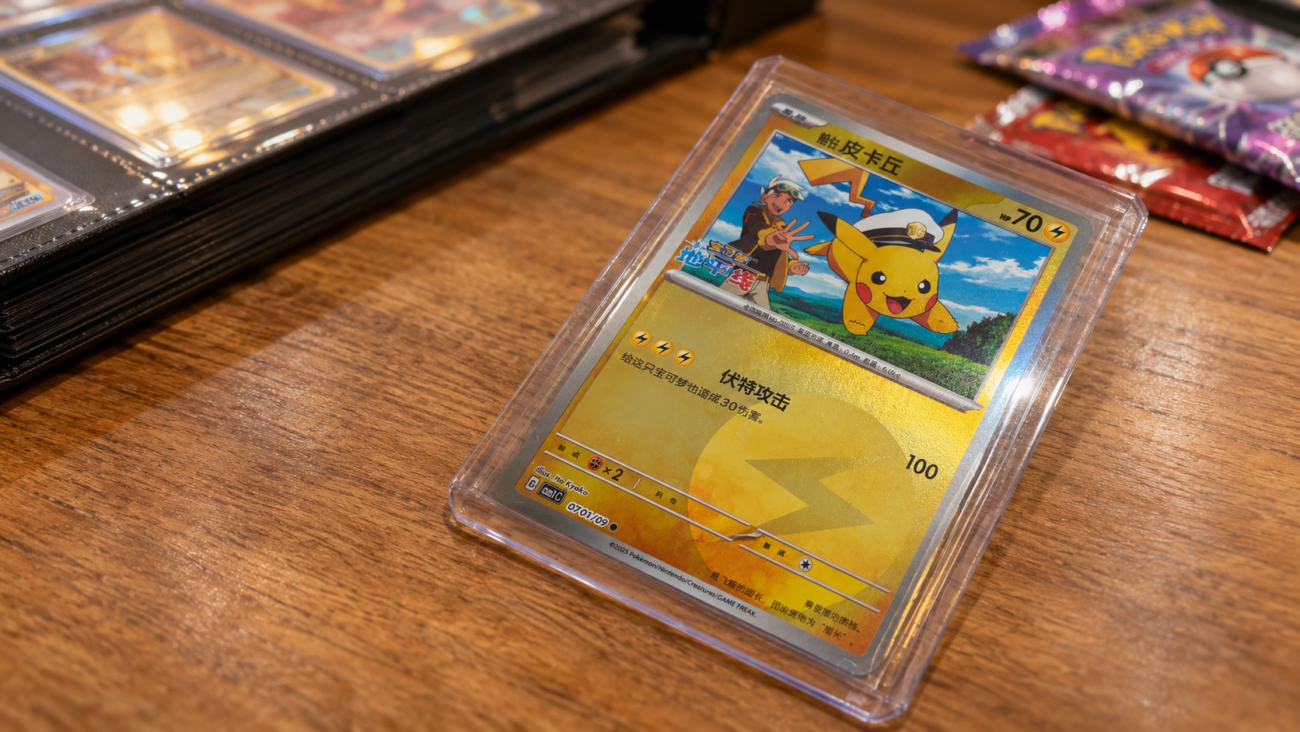
Japanese marking Simplified Chinese marking What you’ll see on an English card English rarity name C · Common C ● Black circle Common U · Uncommon U ◆ Black diamond Uncommon R · Rare R ★ Black star Rare RR · Double Rare RR ★★ Two black stars Double Rare AR · Art Rare AR ★ One gold star Illustration Rare SR · Super Rare SR ★★ Two silver foil stars Ultra Rare SAR · Special Art Rare SAR ★★ Two gold stars Special Illustration Rare UR · Ultra Rare UR ★★★ Three gold stars Hyper Rare There’s a twist for anyone collecting Chinese Gem Packs. These have their own system of symbols. The full-art Captain Pikachu from Gem Pack Volume 1 carries three stars, which makes it a Three-Star Rare in that set.
One of the other customers offered a more pragmatic view. She preferred buying a specific card she wanted, even if it cost a little more upfront, rather than purchasing packs and hoping to find it.
From a financial perspective, that makes considerable sense. If you want a particular $50 card, buying it for $50 is a more predictable proposition than spending $200 (or more) opening packs in the hope of finding it.
But, of course, it removes the thrill of the chase. And the thrill of the chase is precisely what makes opening packs so popular.
What makes a Pokémon card valuable?
As with antique books, four broad factors determine the value of a collectible Pokémon card: rarity, condition, desirability and provenance.
Rarity is the most obvious, although it can be misleading. A card may be scarce because it was distributed at a particular event, produced for a competition or included in a limited promotional release. Other cards may be difficult to find simply because relatively few examples have survived in good condition.
Condition is enormously important. Collectors examine everything from surface scratches and damaged corners to the precise alignment of the printed artwork.
Desirability is less predictable. Charizard, Pikachu and certain other Pokémon have developed enormous followings. Some cards command high prices despite relatively substantial populations because so many people want them.
Provenance can also matter, particularly for unusual promotional cards, trophy cards or examples associated with significant events.
The combination can produce some extraordinary valuations. At the first Chatswood store, I spotted a card priced at more than A$15,000.
I found myself staring at it for a moment, wondering who might walk into a small office a. few floors above the local Warhammer shop and casually spend that sort of money on a Pokémon card. Apparently, somebody does.
Grading: The difference between a good card and a great one
The professional grading industry has become central to high-value Pokémon collecting. Companies such as Professional Sports Authenticator (PSA), Beckett and CGC assess cards for authenticity and condition before sealing them inside tamper-evident plastic holders. PSA uses a scale from 1 to 10.
| Grade | Description |
|---|---|
| PSA 10 | Gem Mint — virtually perfect |
| PSA 9 | Mint — excellent condition with minor imperfections |
| PSA 8 | Near Mint-Mint — slight visible imperfections |
| PSA 7 | Near Mint — modest wear |
| PSA 6 and below | Increasing levels of wear, damage or manufacturing imperfections |
A PSA 10 can command a substantial premium over an otherwise identical PSA 9. Sometimes the difference is hundreds of dollars. For particularly desirable cards, it can be thousands. The grading process considers centring, corners, edges and surface condition. Even a card taken directly from a new packet may not achieve a perfect grade because of manufacturing imperfections.
Importantly, grading is not free. There are assessment fees, shipping costs, insurance considerations and turnaround times. For a card worth $10, grading may make little economic sense. For a card potentially worth thousands, independent authentication can make it considerably easier to sell.
Collectors also need to understand population reports, which show how many examples of a particular card have received each grade. A card with only a handful of PSA 10 examples may attract a significant premium. But if hundreds of additional perfect examples subsequently enter the market, that scarcity premium may disappear.
How do you know what a card is worth?
At the first shop, Rice Collects, a friendly fellow wearing a moon boot, another long story, had given me a rundown of how Pokémon cards are priced. He explained that the business relied on a combination of online pricing tools, recent sales and market comparisons.
The shop itself was a wonderfully understated affair. Two rooms, beige walls and the general atmosphere of a small, but colourful, suburban accounting practice. One staff member sat at a desk examining a computer screen while the fellow in the moon boot moved around the shop, checking stock and helping customers.
There was a steady stream of visitors, most of them older than I had expected, generally in their twenties. K-pop and anime theme songs played moderately quietly through a speaker system. At one point, the fellow in the moon boot began singing the Teenage Mutant Ninja Turtles theme song. It was a slightly surreal moment.
My son, meanwhile, was attempting to arrange his card swap, which required the staff to check an email trail before proceeding. With $15,000 in mind I took opportunity to investigate the pricing system. Unlike shares, Pokémon cards do not trade on a centralised exchange with transparent bids and offers.
Instead, prices are established through a network of specialist retailers, online marketplaces, auction houses and pricing services. Some of the most useful include:
- PriceCharting — historical prices for raw and graded cards.
- TCGplayer — widely used for English-language card prices.
- PSA — grading information, population reports and auction prices.
- eBay — particularly useful for examining completed sales rather than asking prices.
- Cardmarket — an established European trading-card marketplace.
The important distinction is between what somebody is asking for a card and what somebody has actually paid. A seller might advertise a card for $5,000, but that doesn’t necessarily mean it is worth $5,000.
If the last five comparable examples sold for $2,000, the asking price may be little more than wishful thinking. Condition, grading company, language, print variation and recent sales all need to be considered.
There is also the question of liquidity. A rare card might theoretically be worth $15,000, but finding somebody willing to pay that amount could take weeks or months. And when it eventually sells, commissions, postage, insurance and grading expenses can take a meaningful bite out of the proceeds.
A multibillion-dollar market without a stock exchange
Just how big has the Pokémon card market become?
According to The Pokémon Company’s own figures, more than 85 billion Pokémon cards had been manufactured worldwide by the end of March 2026, with cards sold in 16 languages across more than 90 countries and regions.
TCGCharts, a specialist market-data service, estimates the aggregate value of tracked graded Pokémon cards at approximately US$16.4 billion, with more than US$200 million in recorded sales over a recent 30-day period. This is a modelled valuation, not cash that could necessarily be realised if everybody tried selling at once.
For a hobby built around small pieces of printed cardboard, those are extraordinary numbers. And yet there is no universally recognised global exchange for Pokémon cards.
There are marketplaces, auction houses, dealers, grading companies and pricing applications, but nothing quite equivalent to the stock exchange, where buyers and sellers can see a consolidated market price.
Perhaps the industry has become large enough to justify one. A global marketplace combining authenticated grading records, population data, verified transactions, transparent bids and offers, and international settlement would make price discovery considerably easier.
The problem, of course, is that a Pokémon card is not a standardised financial instrument. Two examples of the same card can have different values because of their condition, while even two cards carrying identical grades may attract different prices because of their visual appeal.
Nevertheless, as the market becomes increasingly international, the opportunity for more sophisticated trading infrastructure seems obvious.
The equipment: Looking after your collection
One thing I learnt quickly is that serious Pokémon collecting requires a surprising amount of plastic. At a minimum, collectors should consider protective sleeves, rigid card holders and suitable storage.
The basic equipment includes:
- Penny sleeves: Thin, inexpensive plastic sleeves that protect against scratches and handling.
- Toploaders: Rigid plastic holders used with a soft sleeve for more valuable cards.
- Side-loading binders: Useful for organising collections and displaying artwork without repeatedly handling the cards.
- Graded-card cases: Tamper-evident holders supplied by professional grading companies.
- Storage boxes: Suitable for larger quantities of ordinary cards, ideally kept away from moisture, heat and direct sunlight.
- A magnifying glass and good lighting: Helpful for checking scratches, corner damage and printing defects before buying.
Avoid rubber bands, loose storage and unnecessary handling. For expensive cards, even small amounts of damage can translate into a substantial reduction in value.
Counterfeits are another consideration. Expensive purchases warrant careful authentication, including verification of grading certification numbers and the physical holder itself.
At the second shop, the woman behind the counter kindly gave me a Chinese Captain Pikachu card from the inexpensive bulk stock, complete with a protective sleeve.
It was a nice little gesture, and a useful reminder that not every card needs to be worth hundreds of dollars to be interesting.
Investing or collecting?
There are essentially three types of Pokémon card buyers.
The first are the traditional collectors. They want particular characters, sets, illustrations or promotional releases. Their satisfaction comes from owning the cards rather than necessarily selling them.
The second are investors and speculators. They purchase cards or sealed products in the expectation that prices will rise, sometimes paying substantial premiums for professionally graded examples.
The third are those who enjoy the excitement of opening packs, hoping to uncover something rare or valuable.
Naturally, there is considerable overlap between the groups.
The fellow opening eight packs at the little table was a good example. He enjoyed the anticipation and clearly valued the cards he discovered, but admitted that he rarely sold anything. My daughter, by contrast, was buying artwork.
Both approaches are perfectly legitimate hobbies, although the financial outcomes may be very different.
As an investment, Pokémon cards have some attractive characteristics. They are tangible, internationally recognised, relatively easy to store and supported by an enormous established fan base. But they also carry substantial risks.
Prices can be volatile. Popularity changes. New releases compete for collectors’ attention. Grading and transaction costs reduce returns, and finding a buyer can be difficult. There is also the question of supply.
The Pokémon Company has produced billions of cards and continues to manufacture enormous quantities every year. While particular promotional releases may remain genuinely scarce, modern collectors are often very good at preserving cards in pristine condition.
Today’s rare card may not be nearly as scarce in 20 years as collectors imagine. As with antique books, I suspect the best approach is to buy something you genuinely appreciate, understand what makes it desirable, and regard any subsequent increase in value as a bonus.
A rather enjoyable little world
I came away from my visits to Chatswood with a new appreciation for Pokémon collecting. There was something charming about these two little businesses tucked away in anonymous office towers.
In the first, a fellow in a moon boot was explaining the economics of collectible cards while occasionally singing the Teenage Mutant Ninja Turtles theme song.
In the second, a woman was patiently explaining Chinese releases, artwork variations and the economics of booster boxes while a customer sat nearby opening packs in search of something special.
Neither shop looked remotely like the centre of a multibillion-dollar international collectibles industry. Yet that is precisely what they were participating in.
What particularly surprised me was the age of the customers. These were not primarily children spending their pocket money. They were adults in their twenties and beyond, much like my own children, enthusiastically pursuing a hobby that many had first encountered at school.
Perhaps that is the real secret of Pokémon’s success. It combines nostalgia, art, competition, collecting and the occasional possibility of discovering something genuinely valuable.
There is also something satisfying about owning a physical object, however modest. My complimentary Captain Pikachu card is unlikely to fund my retirement. But I rather like it. And that, ultimately, is probably the best reason to collect anything.
Pokémon cards are a little bit of fun, with some potential financial upside if you know what you are doing and are fortunate enough to acquire something desirable. At the end of the day, however, even an A$15,000 Pokémon card is just a flashy piece of cardboard. Although, unlike a meme coin or an NFT, when the power goes off, at least you can still hold it in your hand.
Disclaimer: The information contained in this article is provided for general information and educational purposes only and does not constitute financial, investment or legal advice. It does not take into account your personal circumstances, financial situation or investment objectives. Readers should conduct their own research and seek independent professional advice before making any investment decisions. While reasonable care has been taken to ensure accuracy, no guarantee is given as to the completeness or reliability of the information.