Sixty years after decimal currency arrived, Australians are queuing overnight for new coins and paying six figures for old ones. Here’s where the real value lies, and what it costs to chase it.
This year a crowd camped outside the Royal Australian Mint in Canberra, waiting for the doors to open on a set of Bluey coins. The silver ones sold out, and it ranked among the busiest launches the Mint has ever had. The Mint reckons between one in four and one in five Australians collect coins, and plenty of them started with a jar handed down from a parent or grandparent.
2026 marks 60 years since Australia switched to decimal currency, and demand has rarely been stronger. So is there real money in coins, or is it mostly nostalgia? The honest answer is a bit of both.
Start with your change
You don’t need a vault to get started. A handful of decimal coins in everyday circulation are worth far more than their face value, if you know what to look for.
The best known is the year 2000 $1/10c ‘mule’. A technician at the Mint accidentally paired the Mob of Roos dollar design with the Queen’s head side meant for the 10 cent coin. You’ll spot one by the double rim around the Queen’s head. In good condition they’ve sold for anywhere from about $1,000 to more than $2,700 at auction.
Other coins worth a second look include the 1966 20 cent with the ‘wavy’ baseline on the 2, and the 1966 round 50 cent. The round 50c is 80 per cent silver, and most sell for somewhere between $20 and $60, depending on condition.
Most of what you’ll find in your wallet is worth exactly what it says. But checking costs nothing.
The top end
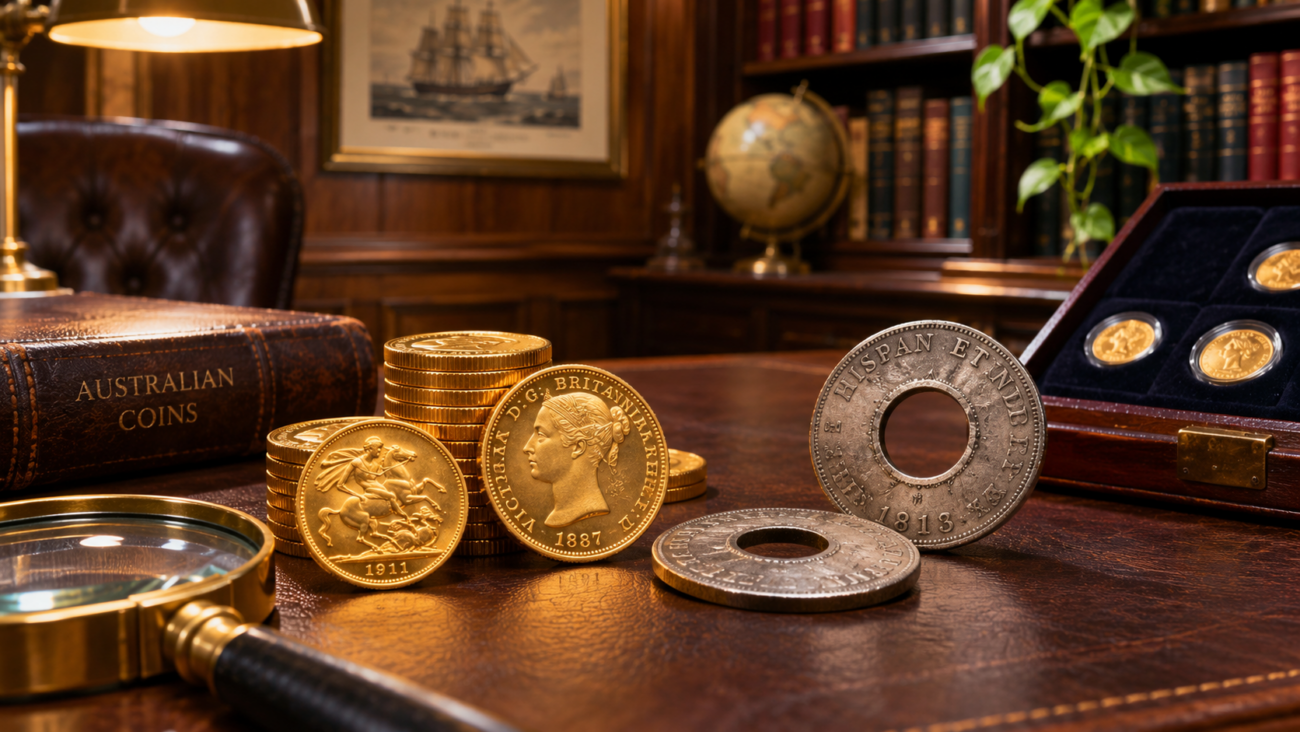
At the other extreme is the coin every Australian collector dreams about: the 1930 penny. Only a tiny number were ever struck, and roughly 1,500 are thought to survive. Even worn examples now sell for tens of thousands. Melbourne dealer Coinworks sold one in November 2025 for $40,000, and two years earlier it had sold a similar-grade coin for $30,000. Late last year the finest known circulated example went under the hammer at International Auction Galleries for a world-record $158,600. The very rare proof version sold privately for $1.15 million in 2019, still the most ever paid for an Australian coin.
Paper money has its stars too. At the same IAG auction, a 1914 emergency ‘Rainbow’ pound and a 1920 fifty pound note fetched $87,230 between them.
The new-release rush
Modern collector coins are where a lot of the current excitement is. Many 2026 issues have sold out at the Mint within days. The 30,000-coin run of the 50c marking the centenary of Queen Elizabeth II’s birth sold out quickly. So did the 2,026 silver proof sets made for the decimal anniversary, which cost $415 each.
A sell-out isn’t the same as a sound investment, though. Some sold-out coins do climb on the secondary market. Others settle back near their issue price once the hype passes. If you’re buying new releases, buy them because you like them, not because you expect them to double.
Gold and silver: a double-edged sword
Coins made of precious metal give you a safety net: they’re always worth at least their melt value. That’s been a big plus lately. Gold hit a record of more than A$7,700 an ounce in late January 2026. A single gold sovereign, with less than a quarter of an ounce of gold, now sells for about $1,570 at the Perth Mint.
But metal prices cut both ways. By early November gold had dropped back to around A$5,500 an ounce, nearly 30 per cent below its peak. For common gold coins, where the metal makes up most of the value, your return mostly depends on what gold does.
Super, tax and the costs no one mentions
Some investors hold coins through a self-managed super fund, but they’re a niche choice. ATO figures show SMSFs held $633 million in collectables and personal-use assets at the end of June 2025. That’s less than 0.1 per cent of the $1.01 trillion in all SMSFs.
The rules help explain why. Coins held in super must be insured in the fund’s name within seven days of purchase. They can’t be stored or displayed in the home of a member or related party, and trustees must keep written records of where they’re stored and why.
Tax applies outside super too. The ATO classes coins as collectables, so capital gains tax is payable on a profit from any coin you bought for more than $500. Losses on collectables can only be offset against gains on other collectables.
Then there’s the cost of buying and selling. Dealers need a margin between their buy and sell prices, and auction houses usually add a buyer’s premium to the hammer price, which can be more than 20 per cent. Add insurance and secure storage, and a coin often has to rise a long way in value before you’re actually ahead.
Before you buy
- Learn to grade. Condition is everything. The difference between ‘Very Fine’ and ‘Extremely Fine’ can be thousands of dollars on the same coin.
- Buy from established dealers. Choose ones with a physical shop, a long track record and a clear returns policy, especially for anything expensive.
- Be careful online. Fakes and over-graded coins are common on marketplaces. Wait until you can judge a coin yourself before buying online.
- Get the paperwork. Keep receipts, certificates and grading slabs. You’ll need them for insurance, for tax, and when you sell.
- Collect what you enjoy. Returns are never guaranteed. A collection you love is worth keeping even in a flat market.
Disclaimer: The information contained in this article is provided for general information and educational purposes only and does not constitute financial, investment or legal advice. It does not take into account your personal circumstances, financial situation or investment objectives. Readers should conduct their own research and seek independent professional advice before making any investment decisions. While reasonable care has been taken to ensure accuracy, no guarantee is given as to the completeness or reliability of the information.