The Cat Who Circumnavigated Australia
In July 1801, a young British naval officer named Matthew Flinders sailed from England on a voyage that would help pin down the shape of an entire continent.
His mission was ambitious. He meant to explore and chart the Australian coastline, settle once and for all whether it was one continuous landmass, and fill in the sizeable gaps left by earlier European navigators. It was a risky business. The coastline was enormous, much of it was barely charted, and his ship, HMS Investigator, was not exactly the pride of the Royal Navy.
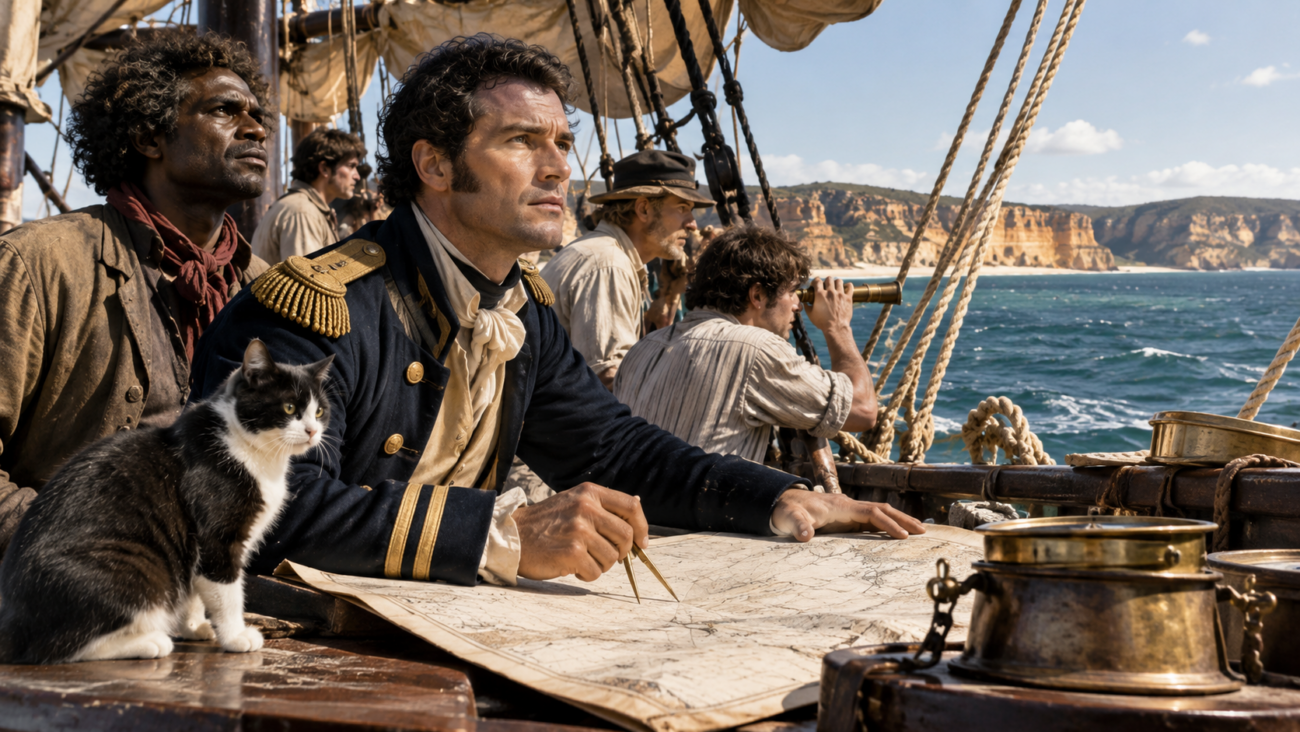
Fortunately, Flinders had an excellent travelling companion. Unfortunately, it was a cat.
His name was Trim. He was a black-and-white cat born at sea in 1799, and he had already shown real promise as a sailor. On one occasion he fell overboard, swam back to the ship and hauled himself up a rope. Impressive stuff, given that most cats treat a puddle as a personal insult.
Flinders adored him. Trim climbed the rigging, hunted rats and developed a keen interest in other people’s dinners. According to Flinders, he would wait patiently for a guest to look away, then help himself to whatever was on their plate. He was, by all accounts, a seasoned thief.
But Trim wasn’t the only remarkable member of the crew. Also aboard was Bungaree, an Aboriginal man from the Broken Bay region north of Sydney. Bungaree had sailed with Flinders before and was an experienced traveller, communicator and go-between. Along the coast, he helped the expedition make contact with Aboriginal communities, often in situations where neither side understood the other’s language or intentions.
That mattered enormously. The British were sailing into unfamiliar waters and meeting people whose cultures, languages and customs they knew almost nothing about. Bungaree could draw on his own knowledge and experience to help bridge the gap. He wasn’t just another member of the crew. He was a genuine participant in one of the great voyages in Australian maritime history. And unlike Trim, he generally kept his paws off the dinner table.
A Very Large Island
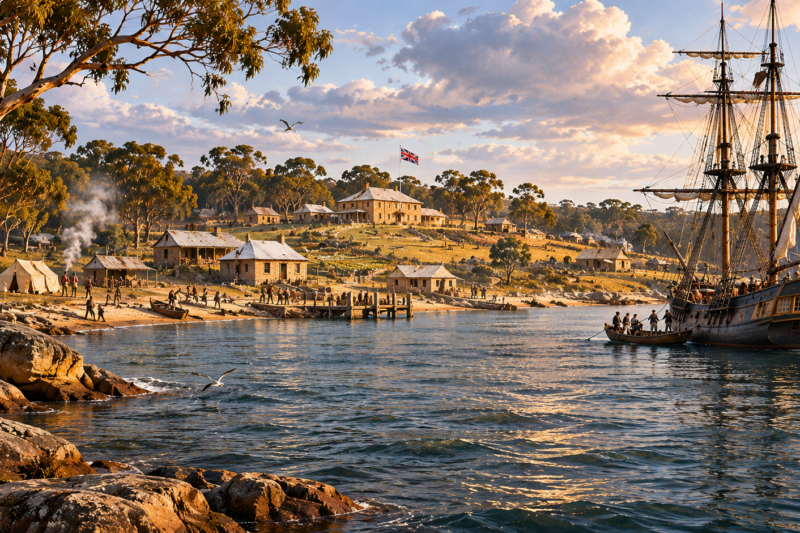
The British had planted their flag at Sydney Cove in 1788, but they still knew surprisingly little about the continent they’d claimed. Europeans had been poking around its edges for more than two centuries. The Dutch had charted stretches of the west and north coasts, Abel Tasman had bumped into the island later named Tasmania, and James Cook had mapped much of the east coast in 1770.
Flinders had already filled in one of those gaps himself. In 1798, he and the naval surgeon George Bass sailed right around Van Diemen’s Land in the Norfolk, a sloop barely 28 feet long, built from Norfolk Island pine. Until then, nobody in Europe knew for sure whether the place was an island or a big chunk hanging off the bottom of the mainland. It was an island, and the channel separating it became Bass Strait, sparing ships bound for Sydney a long detour around the south. Not bad for a boat you could just about park in a modern driveway.
But there were big gaps. Nobody had completed a recorded European circumnavigation of the mainland, and some still wondered whether the east and west might be split by a great inland sea. Flinders intended to find out.
In December 1801 the Investigator reached the south-west coast and began charting the southern shoreline. In April 1802, Flinders ran into the French explorer Nicolas Baudin at what became Encounter Bay, near present-day Victor Harbor in South Australia.
This was awkward. Britain and France had been at each other’s throats for years, although a temporary peace had just been patched together. Yet here were two naval officers from rival powers, charting the same stretch of coast. They swapped information, compared notes and went on their way. A remarkably civilised encounter, considering their countries spent most of the era trying to sink each other’s ships.
Flinders carried on east to Port Jackson, then headed north to tackle the top end. By June 1803 the Investigator had completed its lap of the mainland. It was a remarkable achievement, and it very nearly killed everyone aboard. The ship was rotting, supplies were thin and illness had taken a heavy toll on the crew.
Flinders had proved Australia was one enormous continent. Unfortunately, he’d also proved the Investigator was no longer a reliable way of getting around it.
The Man Who Named Australia
For years, European maps had used names like New Holland and Terra Australis for different chunks of the continent. Flinders was a strong advocate for calling the whole thing Australia. He wasn’t the first to use the word, but his maps and writings did a great deal to make it stick. It also had the considerable advantage of being simpler than explaining whether you meant New Holland, New South Wales or some other bit of coastline Europeans were still trying to work out.
Flinders wanted to get home and publish his findings. First, though, he needed a ship that wasn’t falling to pieces. He left Sydney aboard HMS Porpoise in August 1803. The ship promptly struck a reef off the Queensland coast and was wrecked. Flinders survived, then sailed hundreds of kilometres back to Sydney in a small open boat to organise a rescue.
Undeterred, he set off for England again, this time in a small schooner called the Cumberland. It leaked badly. By now Flinders must have suspected the Royal Navy had something against giving him a seaworthy boat.
He limped into Mauritius, then a French possession, hoping for repairs. There was just one problem. Britain and France were at war again. The French governor suspected him of spying and detained him. For more than six years.
Trim went into captivity with him but later vanished. Flinders feared his beloved cat had been stolen and eaten, though nobody knows for sure what happened. It was a sad end to one of the great feline careers in maritime history.
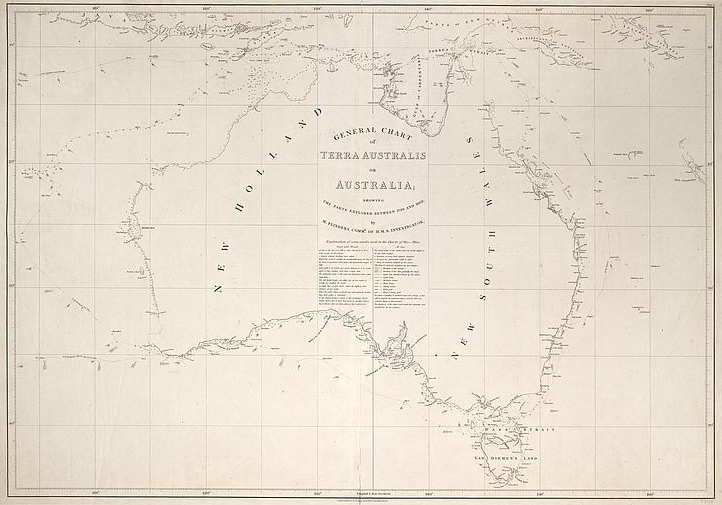
Matthew Flinders map of Austalia, cartographer, G and W Nicol, publisher 1814 – National Library of Australia
Fun Fact: A Cat Outside the Library
Trim has not been forgotten. Today a bronze statue of him sits beside Matthew Flinders outside the State Library of New South Wales in Sydney. It’s a fitting tribute to an animal who travelled thousands of kilometres, survived extraordinary adventures and built a reputation for nicking people’s dinner.
Flinders even wrote an affectionate, tongue-in-cheek biography of Trim, describing him as an unusually intelligent and distinguished member of the feline species. More than two centuries on, visitors still stop to give the little cat a pat.
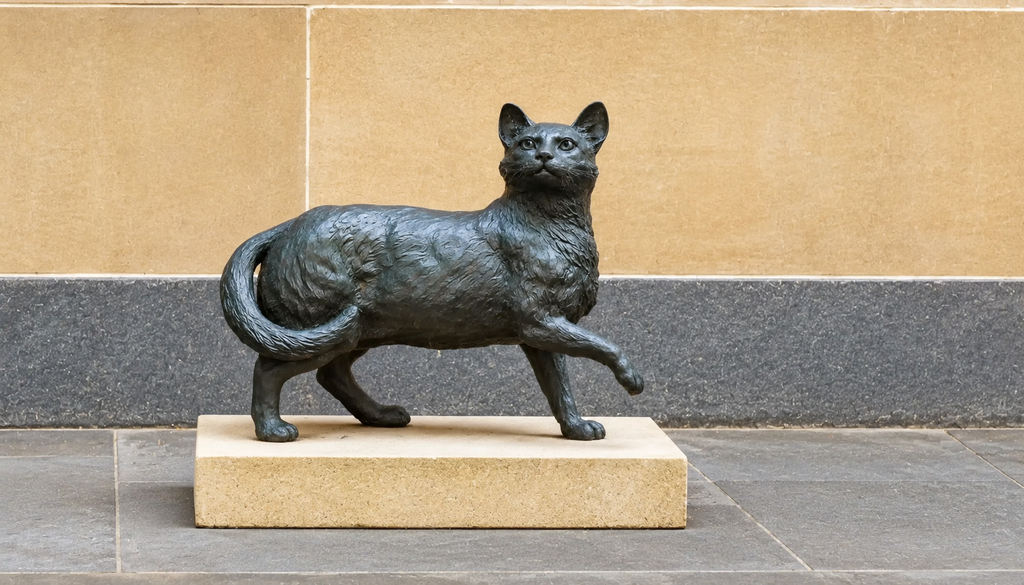
Not bad for an animal whose main contribution to navigation seems to have been eating the ship’s rats.
The Colony Was Getting Crowded
While Flinders was busy with the coastline, Sydney was changing. The struggling penal colony of 1788 was slowly turning into a permanent society, with farms, businesses, government buildings and a growing number of free settlers. Convicts kept arriving, and the place still ran on their labour. But the authorities in London were starting to think beyond Sydney.
Australia had an enormous coastline, several promising harbours and vast stretches of country that Europeans reckoned might suit farming and grazing. There was a strategic angle too. The British had no wish to see the French setting up shop nearby, and the French had already shown an inconvenient interest in the region. The British Empire was not big on sharing.
The result was a string of new settlements around the coast. Some began as convict outposts. Others grew out of commercial ventures and private settlement. All of them were built on land already occupied by Aboriginal peoples.
A Van Diemen’s Land: The Island Prison
A Thousand Quiet Losses
The British knew perfectly well that Aboriginal people lived in Australia. They encountered Aboriginal communities regularly, traded with them, employed them, fought with them and sometimes relied on their knowledge to survive. The fundamental issue was that British authorities did not recognise Aboriginal systems of land ownership as equivalent to European property rights.
To European eyes, ownership was demonstrated through farms, fences, buildings and legal documents. Aboriginal communities often moved seasonally across their traditional country, following established patterns of hunting, fishing and gathering. They had their own territories, laws and obligations to the land, but these were not always apparent to newcomers accustomed to European property boundaries. Indeed, many settlers interpreted this seasonal movement as evidence of an absence of territorial ownership.
The British therefore treated much of Australia as land that nobody owned, at least in any way their legal system recognised. It was a convenient interpretation, allowing the Crown to claim enormous areas of territory and then grant or sell them to settlers.
As settlement expanded, pastoralists occupied vast tracts of country, introduced livestock, restricted access to water and transformed entire landscapes. Disease spread through Aboriginal communities, often with devastating consequences. Violence, dispossession and, increasingly, government policies of removal compounded the disruption. The circumstances varied from region to region, but the pattern was repeated across colonial Australia: opportunities for European settlers frequently came at the expense of Aboriginal people.
None of this happened in a gentle age. The late eighteenth and nineteenth centuries were brutal for a great many people. A convict’s life was no picnic, and neither was that of a farmhand or a city labourer. But Aboriginal people were losing far more than an easy living. Pushed to the edges of the new society, many found a place there as best they could. Intermarriage, particularly between Aboriginal women and settler men, became common. In the eastern colonies especially, languages, ceremonies and traditional ways were slowly lost.
This contradiction became one of the defining features of Australia’s colonial history. The British saw settlement as progress. For many Aboriginal communities, it meant losing control of the country that had sustained their ancestors for generations, followed by a slow, fits-and-starts integration into an alien society. Both stories are part of Australia’s history, and neither makes much sense without the other.
Van Diemen’s Land: The Island Prison
The first big expansion beyond mainland New South Wales came in 1803, when a British party under Lieutenant John Bowen set up camp at Risdon Cove on the Derwent River in Van Diemen’s Land. The following year, Lieutenant-Governor David Collins established a settlement at Sullivan’s Cove, which became Hobart.
The island was named after Anthony van Diemen, a Dutch colonial governor who never set foot on it. Abel Tasman had come across it in 1642 and named it in his boss’s honour. It wouldn’t officially become Tasmania until 1856.
For early British settlers, Van Diemen’s Land offered fertile valleys, timber, grazing country and handy harbours. It also offered somewhere to send convicts, and the authorities made the most of that. Over the following decades the island became one of the main destinations for transported prisoners. Convicts built roads, cleared land, put up buildings and worked for private settlers. Some were assigned to farms and businesses. Others endured brutal punishment in places that became notorious across the Empire, the best known being Port Arthur, established as a penal station in 1830.
But Van Diemen’s Land wasn’t just a prison. Free settlers arrived, farms spread and towns grew. Sheep and cattle came in, pastoralists took up big tracts of land, and the island’s wool industry grew alongside that of New South Wales.
For settlers with capital and connections, there were fortunes to be made. For convicts, the opportunities were rather more limited. And for Aboriginal Tasmanians, the consequences were devastating. Through the 1820s and early 1830s, the conflict with the indigenous population escalated into what became known as the Black War. Some 600 to 900 Aboriginal people and more than 200 British settlers died in what can only be described as an intermittently intense guerrilla war.
By 1830 the violence had come to a head, and Lieutenant-Governor George Arthur organised an extraordinary military operation. Thousands of soldiers, settlers and convicts were strung out in a line more than 300 km long, meant to sweep across significant areas of the island and capture Aboriginal people or drive them out of the settled districts. It became known as the Black Line.
It was hugely expensive and achieved very little of what it set out to do. Marching thousands of men through rugged bush while expecting them to hold a continuous line was always going to be a stretch. It was a bit like trying to run a military parade through several hundred kilometres of dense forest.
But the wider colonial campaign of dispossession, violence and forced removal had terrible consequences. Aboriginal survivors were eventually pressured or forced into settlements, including on Flinders Island, where disease, poor conditions and dislocation caused yet more deaths.
Brisbane: The Colony Nobody Wanted to Visit
Meanwhile, the authorities in New South Wales had another problem. Sydney was getting a bit too comfortable. Not for everyone, obviously. But some convicts were earning money, forming relationships and enjoying a degree of freedom that officials felt was unbecoming of a penal colony.
The government wanted somewhere more isolated to send prisoners who reoffended. Somewhere remote. Somewhere unpleasant. Somewhere that would make people think twice about coming back. They chose Moreton Bay.
In 1824 a penal settlement was set up at Redcliffe, north of present-day Brisbane. The site was a dud, so in 1825 the settlement moved to the Brisbane River, which offered better water, a more practical harbour and the considerable bonus of being a very long way from Sydney.
It was named after Sir Thomas Brisbane, governor of New South Wales, a Scottish soldier and astronomer who had the good fortune to get an Australian capital named after him. Most governors had to make do with a street.
Moreton Bay became a place of secondary punishment, for convicts who committed fresh offences after transportation. Conditions were harsh. Prisoners did gruelling physical labour, often in chains, and discipline could be savage. The settlement earned a fearsome reputation, which, from the government’s point of view, was rather the point.
But one of the strangest stories linked to Moreton Bay began before the penal settlement even existed.
The Men Who Were Lost in Paradise
In 1823, four ticket-of-leave convicts set out from Sydney in a small boat, heading south towards the Illawarra. Their names were Thomas Pamphlett, John Finnegan, Richard Parsons and John Thompson.
They ran into wild weather and were blown far off course. Thompson died during the ordeal. The survivors eventually washed up on the Queensland coast, having travelled hundreds of kilometres in entirely the wrong direction. They were convinced they were somewhere south of Sydney. They were, in fact, well to the north. As navigational errors go, it was a fairly substantial one.
The men survived thanks to local Aboriginal communities, who gave them food, shelter and knowledge of the country. They lived in the region for months, moving between different groups. In late 1823, the explorer John Oxley stumbled on Pamphlett and Finnegan while surveying Moreton Bay. The men were rescued, and Finnegan helped Oxley find the Brisbane River.
It was an extraordinary episode. Four men set off for a short trip south of Sydney. Three survived, ended up hundreds of kilometres north, were kept alive by Aboriginal people and helped steer the British towards the site of a future capital city. There are easier ways to make your mark on Australian history.
From Prison to Prosperity
Moreton Bay remained a penal settlement until 1839. Free settlement followed, and Brisbane began to grow into a commercial town. The surrounding district drew pastoralists, timber-getters, farmers and merchants, and sheep and cattle stations spread across the Darling Downs and other grazing country.
In 1859 Queensland split from New South Wales to become a colony in its own right, with Brisbane as its capital. The settlement built to punish troublesome convicts had become the hub of a vast pastoral and agricultural region.
Quite a turnaround. Although the convicts who had spent years working in chains might reasonably have wondered why nobody mentioned the future opportunities earlier.
Melbourne: Two Men, One City
While Brisbane was taking shape as a penal settlement, another colony was forming much further south. Port Phillip Bay had attracted European interest for decades. A British settlement had been tried briefly at Sullivan Bay in 1803 but was abandoned the following year, and for a while the authorities left the area alone.
Then came the pastoralists. By the 1830s, landholders in Van Diemen’s Land were eyeing the wide grasslands across Bass Strait. There was good grazing. There was water. And there was the chance to grab land before anybody else did.
Two men became tied to the founding of Melbourne: John Batman and John Pascoe Fawkner. Neither was especially keen on sharing the credit.
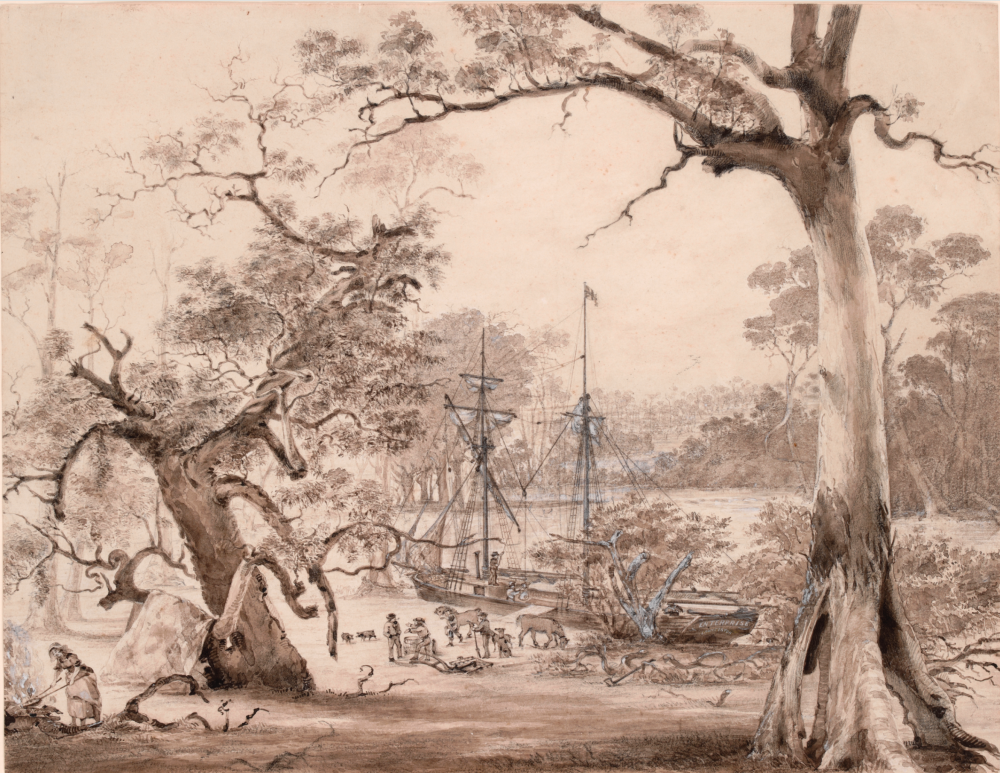
The Enterprize, the ship of John Pascoe Fawkner landing at Melbourne – State Library of Victoria
Batman was a pastoralist and entrepreneur who crossed from Van Diemen’s Land to Port Phillip in 1835. He explored the country around the Yarra River and declared it a fine place for a village. As observations go, it held up well. The spot would become one of Australia’s biggest cities.
Batman also tried something unusual. He claimed to have struck a deal with Aboriginal leaders for the use of huge tracts of land around Port Phillip. The document became known as Batman’s Treaty. The circumstances, including what the Aboriginal signatories understood and what authority they had, remain disputed. But Batman was clearly attempting some kind of land transaction between Europeans and Aboriginal people.
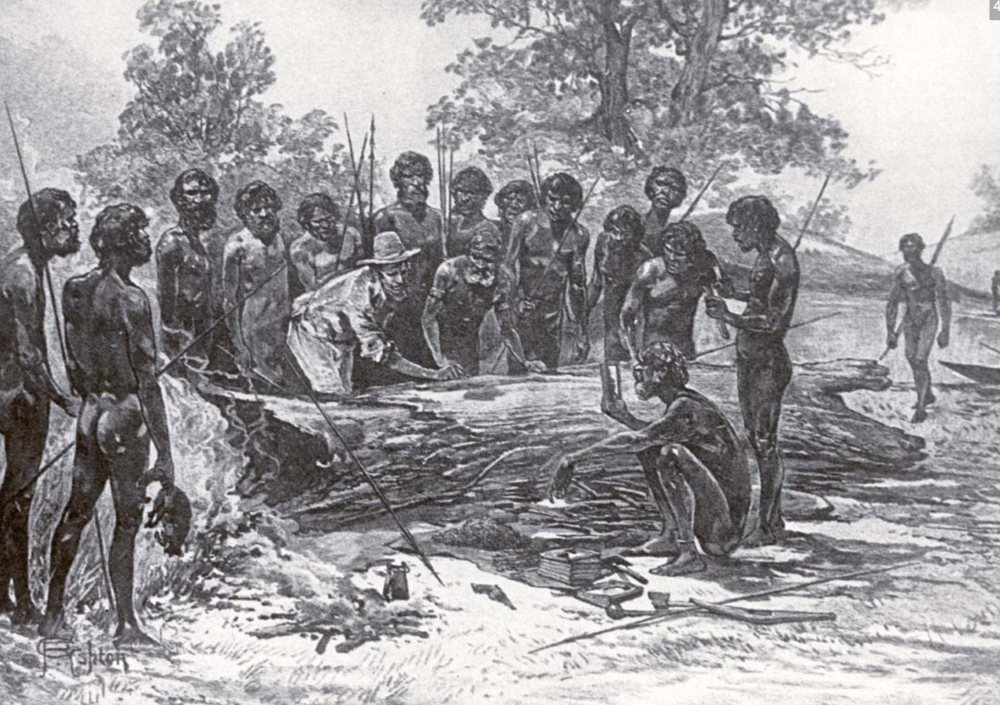
Artist impression of Batman’s Treaty being signed – Atlas of Australasia, 2 vols, Picturesque Atlas Publishing Company, Sydney, 1886
The colonial government knocked it on the head. Governor Richard Bourke declared that private individuals couldn’t acquire land directly from Aboriginal people, because the Crown alone controlled how land was handed out. In other words, Batman couldn’t simply rock up, do a deal with the locals and declare himself owner of a decent slice of Victoria.
It was a remarkable position for the government to take, given that Aboriginal peoples had never agreed to hand their country to the British Crown in the first place.
Enter Mr Fawkner
John Pascoe Fawkner had his own plans for Port Phillip. He was a businessman, newspaper proprietor and former convict who had spent much of his life in Van Diemen’s Land. In 1835 he organised an expedition aboard the Enterprize. Illness kept him off the first voyage, but his party established a settlement on the Yarra, and Fawkner followed later to become one of the town’s loudest cheerleaders.
Batman and Fawkner then spent years squabbling over who deserved to be called Melbourne’s founder. Batman had explored the site and claimed land. Fawkner’s party had actually set up camp. Both had supporters, both had strong opinions, and both were apparently convinced the other bloke was getting far too much credit.
The argument rolled on long after both men were dead. Melbourne had its first great rivalry before the city was properly built, which, given what Victorians would later do with Australian Rules football, seems strangely fitting.
The City That Grew Almost Overnight
Melbourne grew fast. The surrounding grasslands drew pastoralists, sheep stations spread across what became the Port Phillip District, and wool became a major export. Merchants set up shop, ships arrived loaded with goods and migrants, and the little settlement on the Yarra became a substantial town. In 1837 it was officially named Melbourne, after the British prime minister Lord Melbourne, and it kept expanding through the 1840s.
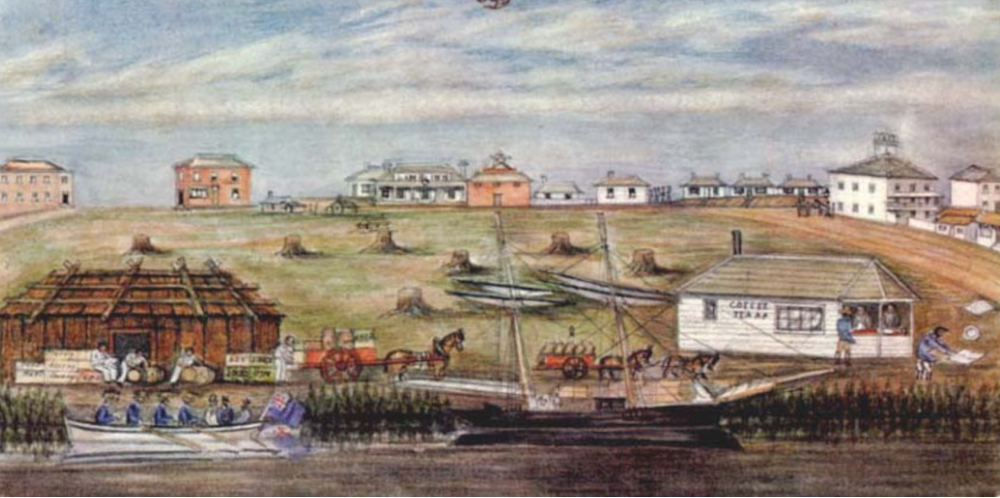
Melbourne Landing,1840; watercolor by W. Liardet (1840)
Then, in 1851, gold was discovered in Victoria, and everything changed. Tens of thousands poured in from Britain, Europe, America and Asia, and Melbourne became one of the fastest-growing cities on earth. That same year, Victoria separated from New South Wales.
Within a generation, a settlement started by a handful of pastoral entrepreneurs had become a rich and increasingly sophisticated colonial capital. Batman and Fawkner would barely have recognised it. Although they’d probably still be arguing over whose idea it was.
Fun Fact: A Continent Named After Strangers
Matthew Flinders helped popularise the name Australia, but he was hardly alone in the colonial passion for naming things. The British had a remarkable habit of naming towns, rivers, mountains and entire regions after governors, politicians, naval officers and assorted royals.
Brisbane was named after Governor Thomas Brisbane. Melbourne got a British prime minister. Adelaide, founded in 1836 as capital of the new colony of South Australia, was named after Queen Adelaide, wife of King William IV. Perth, founded on the Swan River in 1829, took its name from the Scottish town linked to the colonial secretary, Sir George Murray. Sydney had already been named after Lord Sydney, the home secretary. And Governor Lachlan Macquarie threw himself into the practice with real gusto.
Australia was fast filling up with places named after people who had never been here.
A Country Taking Shape
By the mid-nineteenth century, the little settlement at Sydney Cove sat at the centre of a much bigger colonial world. British settlements ringed the coastline, and Hobart, Brisbane, Melbourne, Adelaide and Perth were growing into proper towns. Roads, ports and shipping routes linked communities that were further and further apart.
Free settlers arrived in growing numbers. Farms spread, businesses prospered, and wool paid for a great deal of it. The colonies were still separate political entities, and the continent was a long way from being a nation. But the foundations of modern Australia were starting to show.
The population was getting more varied too. There were convicts and ex-convicts, soldiers, merchants, farmers, tradesmen and labourers. There were people born here and people who had sailed halfway round the world to start again. And there were Aboriginal communities continuing to resist, adapt and survive amid enormous upheaval.
The colony was no longer just a prison at the end of the earth. It was becoming somewhere people chose to live. And for many newcomers, the biggest drawcard was land.
If You Remember One Thing…
Matthew Flinders helped give Australia its shape and its name, while British settlement fanned out from Sydney across the continent. Van Diemen’s Land grew into both a convict colony and a pastoral society. Brisbane started life as an isolated penal settlement and ended up capital of Queensland. Melbourne sprang from rival pastoral ventures and boomed into one of Australia’s great commercial cities.
Each settlement had its own story. Together, they marked Australia’s shift from a remote British prison into a collection of fast-growing colonies. It was a time of remarkable opportunity for many European newcomers, and a time of profound loss and upheaval for Aboriginal peoples.
And somewhere in the middle of it all was a small black-and-white cat who sailed around the continent, survived shipwrecks and earned himself a place in Australian history. His name was Trim, and he probably would have preferred another helping of fish.
Visit It Today
The State Library of New South Wales, Sydney. Start with Flinders and Trim, whose statues stand outside. Inside, the library holds major collections on early exploration and colonial history, so it’s a great first stop if you’re interested in the people who mapped and recorded the continent.
The Tasmanian Museum and Art Gallery, Hobart. The museum covers Tasmania’s natural and human history, including Aboriginal Tasmania and the colonial period. A stroll along Hobart’s waterfront gives you a tangible link to the settlement founded in 1804.
Old Government House, Brisbane. Finished in 1862, it belongs to a later era than the Moreton Bay penal settlement, but it’s a great introduction to Queensland’s early years as a separate colony. For the convict story, visit the Commissariat Store, one of Brisbane’s oldest surviving buildings, built by convict labour in the late 1820s.
The Immigration Museum, Melbourne. Housed in the old Customs House, it tells the stories of the people who migrated to Victoria and shaped the city. Follow it with a walk along the Yarra and through the older streets of the CBD to get a feel for how the 1835 settlement became a great colonial city.
Coming Next: A Land of Opportunity
By the 1830s and 1840s, Australia was attracting a new kind of arrival. These people weren’t coming in chains. They were coming by choice, hoping to build farms, businesses and families in a country that seemed to offer chances they’d never get at home.
Among them were people from Ireland, where hard times, religious divisions and scarce land pushed thousands to try their luck overseas. Some had served in the British Army. Others were tradesmen, farmers and merchants. They brought their skills, their ambitions and, occasionally, their old grudges.
It was a very different world from the penal colony of 1788. Australia was becoming a land of opportunity. Although, as we’ll discover, opportunity sometimes depended on having the right connections, a bit of money and a very good lawyer.
Chapter Four: Riding on the Sheep’s Back, the birth of Australia’s wool industry