In February 1790, Elizabeth Macarthur was aboard a ship bound for Australia. She was heavily pregnant, thoroughly miserable and married to a man who had already managed to fall out with the captain. Not an ideal start to a new life.
The ship was the Neptune, part of the notorious Second Fleet, and even by the standards of convict transports it was grim. Elizabeth, her husband John and their infant son Edward were squeezed in below deck, separated from the female convicts by little more than a partition. The air was foul and the quarters cramped. Following one of John’s arguments with the captain, the passage to the open deck had reportedly been turned into a makeshift sickbay, so getting a breath of fresh air meant stepping past desperately ill convicts.
Elizabeth eventually refused to leave her cabin. John, never one to let a grievance go to waste, demanded the family be transferred to another ship. They were moved to the Scarborough while the fleet sat becalmed in the tropics. Their new cabin was so small they couldn’t stand up straight, but at least they could get onto the deck. In the circumstances, that counted as an upgrade.
Near the end of the voyage, Elizabeth gave birth to a daughter. The baby lived for only about an hour and was buried at sea.
When Elizabeth finally stepped ashore at Sydney Cove on 28 June 1790, she was twenty-three years old, grieving for her daughter and staring down an uncertain future on the far side of the world. She could hardly have imagined she would spend the rest of her life here, or that she would help build one of the country’s most important industries.
And all because of a rather peculiar Spanish sheep.
A Difficult Man to Live With
John Macarthur was an ambitious young officer in the New South Wales Corps. He was intelligent, energetic and commercially sharp, and he had an almost supernatural talent for getting up people’s noses. Over the following years he would quarrel with governors, senior officers and pretty much anyone unlucky enough to stand between him and what he wanted.
In 1801 he fought a duel with his own commanding officer, Colonel William Paterson, and shot him in the shoulder. This was generally considered poor form, even by the standards of the New South Wales Corps, which was really not a very high bar.
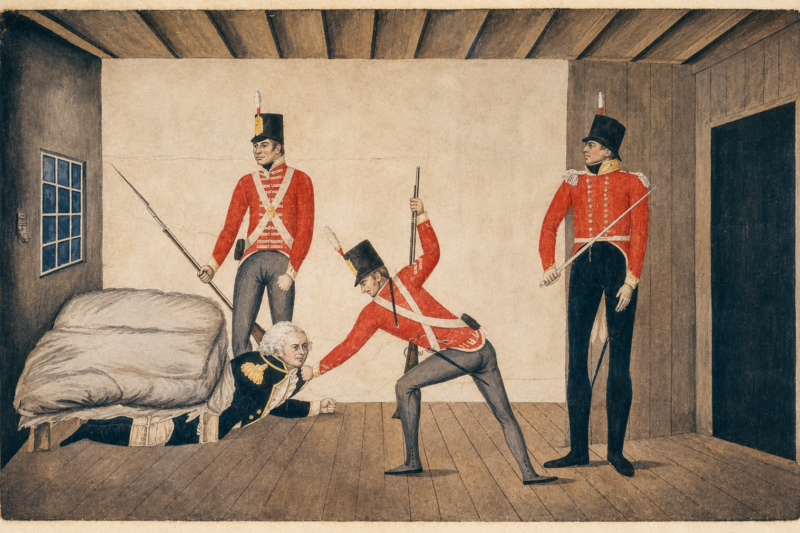
He was packed off to England, where he somehow dodged a court-martial and eventually left the army. Rather than lying low, he spent his time cultivating influential friends and talking up his plans for fine-wool sheep in New South Wales. He was back in Sydney by 1805, and three years later he helped overthrow Governor William Bligh in the Rum Rebellion.
For a man whose great passion was sheep breeding, John Macarthur spent a surprising amount of time upsetting people who had guns. Fortunately, Elizabeth was rather more practical.
Elizabeth Farm
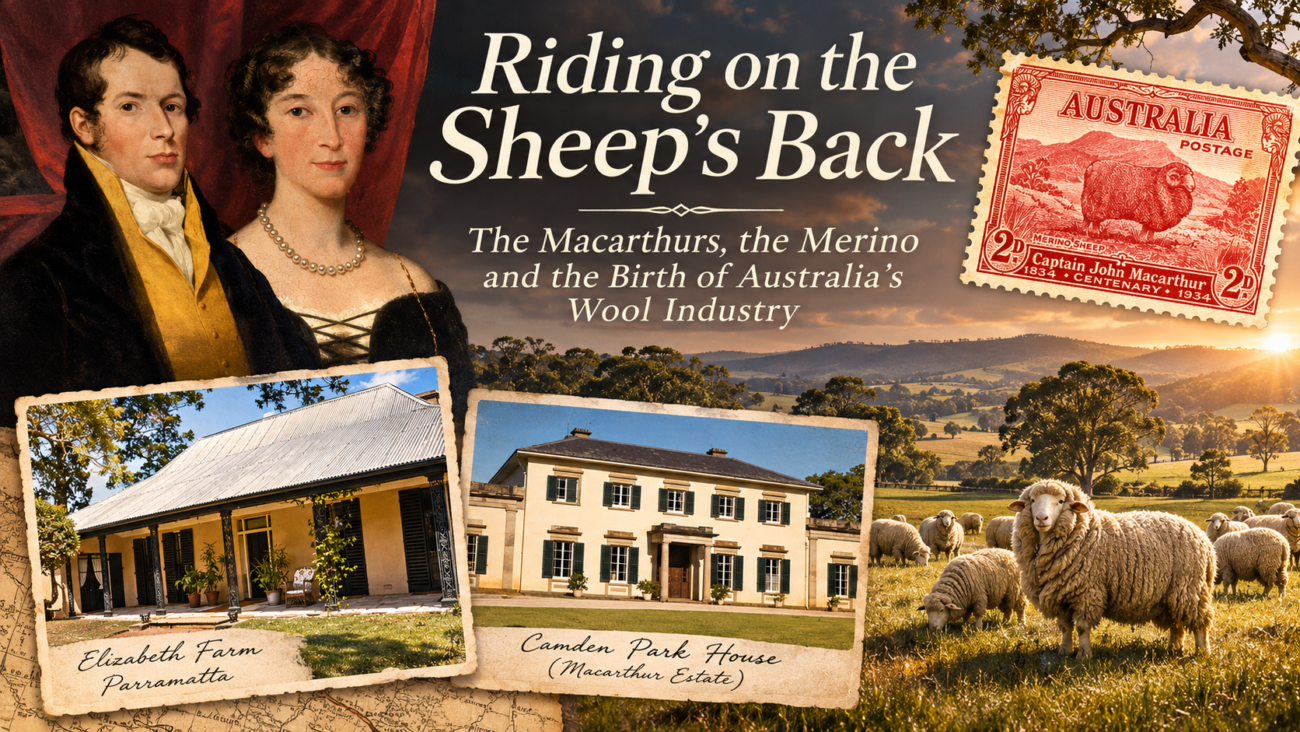
Despite her wretched arrival, Elizabeth adapted remarkably well to life in New South Wales. The Macarthurs took up land at Parramatta and established a farm that John, in a rare romantic gesture, named after his wife. By 1794 Elizabeth Farm had a substantial brick house, surrounded by gardens, orchards and cleared paddocks.
The family grew, and so did Elizabeth’s affection for her adopted home. In letters back to England she wrote about the beauty of the landscape, the pleasant climate and the sheer abundance of fruit and vegetables. She was particularly taken with the flowering trees and shrubs.
This was not quite the picture of Australia doing the rounds in Britain, where the colony was mostly seen as a miserable dumping ground for criminals. Elizabeth saw something else. She saw possibilities.
She was educated, observant and more than capable of managing complicated affairs. Those qualities would come in very handy whenever her husband landed himself in trouble. Which was often.
Enter the Merino
The first sheep brought to New South Wales were there to be eaten. The colony needed food, and sheep were handy because they turned grass into dinner. Their wool was an afterthought.
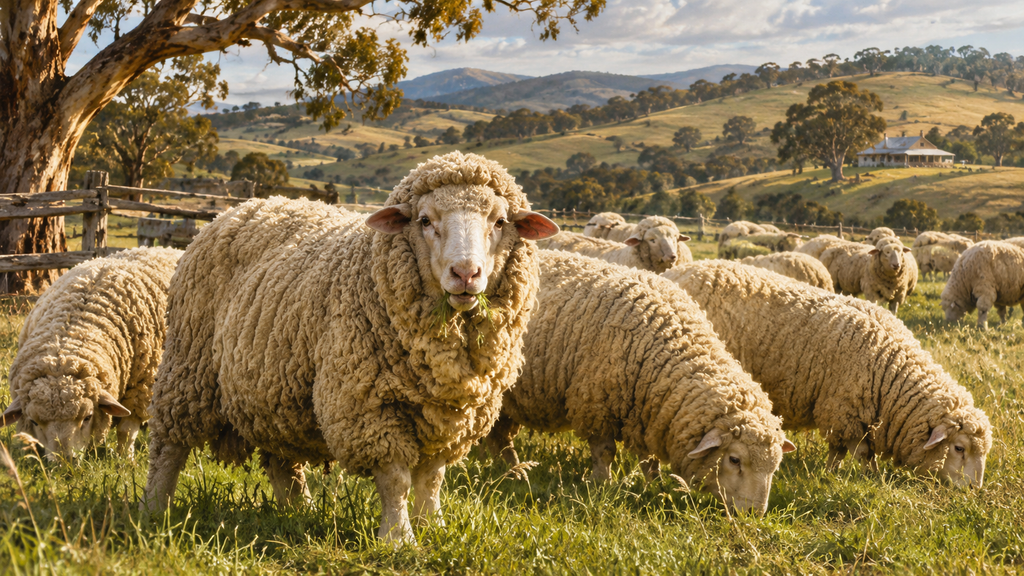
But back in Europe, wool was big business. Britain’s textile mills were expanding at a cracking pace, and the finest wool came from merino sheep, especially those bred in Spain. Merinos grew an exceptionally fine fleece, perfect for high-quality cloth, and for centuries Spain had guarded its merino bloodlines jealously. A good merino wasn’t just a sheep. It was a small, four-legged investment portfolio.
In 1797, Captain Henry Waterhouse and Lieutenant William Kent brought a small flock of merinos to Sydney from the Cape of Good Hope. Getting them here was no mean feat. Bad weather dragged out the voyage and more than half the animals died on the way. Not exactly the triumphant opening of an agricultural revolution.
John Macarthur was interested immediately. He wanted the whole flock, but Waterhouse wasn’t selling. Eventually Macarthur got his hands on some merinos and started his own breeding program. He wasn’t alone, either. Other settlers, including the Reverend Samuel Marsden, were also experimenting with fine-wool sheep.
But Macarthur had spotted the commercial logic. Australia had land. Britain needed wool. And sheep, unlike convicts, didn’t need guarding.
A Very Fine Fleece
By the early 1800s the Macarthurs were building increasingly valuable flocks, selecting animals for the quality of their fleece and working towards a reliable supply of fine wool. This was not a matter of tossing a ram and a ewe into a paddock and hoping for the best. Good wool needed careful selection, decent pasture, healthy animals and years of patient breeding.
Then the wool had to be cleaned, packed, carted to Sydney and shipped halfway around the world. And even after all that, there was no guarantee British buyers would want it.
Macarthur was undeterred. In 1803, while in England after the duel, he won government backing for his plans, including a substantial land grant at Camden. The estate became Camden Park, and it was a major step towards a genuine commercial wool enterprise.
By 1807 the Macarthurs were exporting fine wool to Britain. Samuel Marsden was also an important early producer and exporter, and exactly who sold the first commercial Australian wool has been argued over ever since. What mattered was the bigger picture. The colony Britain had set up to take its convicts was starting to produce something Britain actually wanted to buy.
The timing was handy, too. Britain was at war with Napoleon, and the fighting had disrupted Europe’s traditional wool supplies. A dependable source in a British colony, however far away, suddenly looked very attractive. The only problem was producing enough of it. And that was about to become Elizabeth’s problem.
The Woman Who Kept the Sheep
In 1809, John Macarthur sailed for England to deal with the fallout from the Rum Rebellion. He wouldn’t be back until 1817. Eight years is a long time to leave your wife minding the farm. Especially when “the farm” means several thousand sheep, a small army of workers, multiple properties and a large family.
Elizabeth wasn’t entirely on her own. She had help from John’s nephew Hannibal Macarthur, along with overseers and convict labourers. But responsibility for the precious merino flocks and the fledgling Camden Park estate landed squarely on her shoulders, and she took it seriously.
She travelled between the properties, inspected the sheep, weighed up breeding decisions and kept a close eye on how the estates were run. Some of those trips took her out to the edges of European settlement, through country where relations between settlers and Aboriginal communities were growing increasingly tense. She worked closely with an experienced convict overseer, talking through which rams to select, the condition of the flocks and how to lift the quality of the wool.
Then she wrote it all up in detailed reports to John in England. Letters could take months to arrive. Imagine running a modern agricultural business when every question to your business partner took half a year to get an answer.
Somehow, Elizabeth made it work. John used his years in Britain to line up buyers, influential backers and commercial opportunities. Elizabeth made sure there was actually some decent wool for him to sell. It was an effective partnership, even if one half of it was on the wrong side of the planet.
There was a more personal side to all this, too. Elizabeth had already lost a child on the voyage out. She had raised a big family in a remote colony and put up with her husband’s endless political brawls, and now she faced years without him. Her surviving letters reveal a woman deeply worried about her children, particularly the sons away at school in England.
She could write about sheep, business and farm management with real authority. But she was, above all, a mother separated from part of her family by half the world. For all the money and opportunity Australia offered, the distance from home could be cruel.
The Wool Goes to London
While John was away, the Macarthur enterprise kept growing. The flocks improved, the breeding program got more sophisticated, and Australian fine wool started to earn a name for itself in the British market.
It was still a small industry with some enormous obstacles. Transport was slow and expensive, skilled labour was scarce. But the quality of the wool was getting hard to ignore. British mills were hungry for raw material, Australia had grazing country to burn, and the merino seemed remarkably happy in its new home.
By the time John returned in 1817, the foundations of a successful industry were in place. The Macarthurs weren’t solely responsible. Waterhouse, Marsden and other early breeders all played their part. But John and Elizabeth were central to proving that fine wool could be a serious commercial proposition. And it was Elizabeth who had done much of the hands-on work during the years when nobody knew whether it would pay off.
John Comes Home
When John returned in 1817, Elizabeth gradually stepped back from the day-to-day running of the properties, handing more and more of it to her husband and, increasingly, their sons. The family kept expanding its pastoral interests, and Camden Park grew into one of the great estates of colonial New South Wales.
But the later years of the marriage were not happy ones. John’s behaviour became increasingly troubled, and the couple ended up spending much of their time apart. He died in 1834. Elizabeth outlived him by sixteen years.
By the time she died in 1850, aged eighty-three, Australian wool had become one of the colony’s great export industries. The young woman who had stepped ashore at Sydney Cove grieving for her baby daughter had lived long enough to see the place transformed.
Her husband got most of the credit. For generations, schoolkids learned about John Macarthur and his merino sheep, while Elizabeth was remembered, if at all, as his wife. Yet without her management of the flocks, the estates and the people who worked them, the Macarthur enterprise might have turned out very differently. John had the vision, the connections and a remarkable gift for trouble. Elizabeth kept the show on the road. Between them, they helped establish an industry that would shape Australia for generations.
Fun Fact: The Families That Never Really Left
The Macarthurs did rather well out of wool. So well, in fact, that more than two centuries after John and Elizabeth started building their estates, their descendants are still connected to Camden Park. The historic house and part of the original estate have stayed in family hands, an extraordinary thread running from modern Australia right back to the earliest years of European settlement.
And they weren’t the only family to establish a lasting pastoral dynasty.
Remember William Cox, the man who built the road across the Blue Mountains for Governor Macquarie? His descendants went on to become substantial landowners and pastoralists, establishing estates across New South Wales and Van Diemen’s Land.
The Rouses were another remarkable example. Richard Rouse arrived in 1801, acquired extensive farming and grazing properties, and established the family home at Rouse Hill. Six generations lived in the house before it finally became a museum.
Early colonial Australia offered extraordinary opportunities to those who obtained land, government favour and a few well-placed sheep. Some families turned those advantages into fortunes that lasted for generations.
John Macarthur arrived as a junior army officer in a struggling penal colony. His descendants inherited a place in Australian history, along with a fairly substantial bit of real estate. Not a bad return on a few sheep. Although Elizabeth might reasonably point out that somebody had to look after them.
If You Remember One Thing…
Australia’s wool industry didn’t spring up just because someone shipped a few sheep to Sydney. It took years of breeding, experimentation, investment and plain hard work. John Macarthur was one of its loudest and most determined promoters. But Elizabeth Macarthur played an equally important practical role, particularly during the eight years her husband spent in England.
Wool went on to become one of the foundations of Australia’s economy, and it carved out a lasting piece of the national identity: the sheep station, the shearer, the woolshed and that vast pastoral landscape.
It’s tempting to tell this as the story of an ambitious man who saw the future in a Spanish sheep. But there was also a woman who kept the whole thing running while he was away. And sometimes, that’s the more interesting half of history.
Visit It Today
If you want to see where Australia’s wool industry began, start at Elizabeth Farm in Rosehill, near Parramatta. The house dates from the colony’s earliest years and is one of Australia’s oldest surviving European buildings. It was the Macarthur family home and the hub of their early farming operations, and you can still wander the house and grounds and get a feel for the life Elizabeth knew.
For a longer day out, head to Belgenny Farm at Camden, part of the historic Camden Park estate. Its surviving farm buildings are a direct link to the Macarthurs’ pastoral empire and the early days of fine-wool breeding.
And next time you’re driving through the countryside past thousands of sheep grazing peacefully in a paddock, spare a thought for their ancestors, who helped bankroll much of modern Australia. Not bad for an animal whose main ambition in life is finding more grass.
And Then Came the Squatters
The Macarthurs had helped get the wool industry going. But as demand for Australian wool grew, the sheep began pushing out beyond the settled districts and into the vast interior.
The men driving them weren’t overly fussed about property boundaries, government regulations or whether somebody already lived on the land. They were called squatters, and they were about to make an awful lot of money.
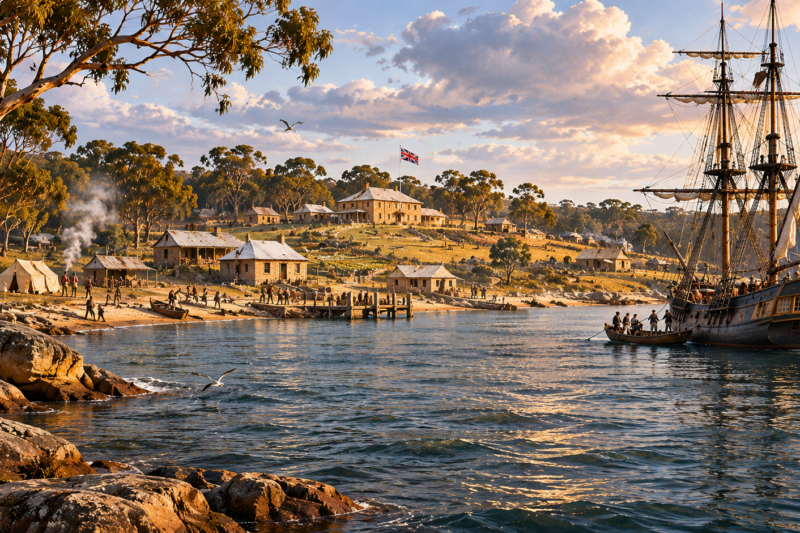
But before we follow the sheep inland, there’s something else to look at. The little settlement at Sydney Cove was no longer alone. The British had begun spreading around the Australian coastline, and one of the men helping them work out just how enormous this country was had a rather remarkable travelling companion.
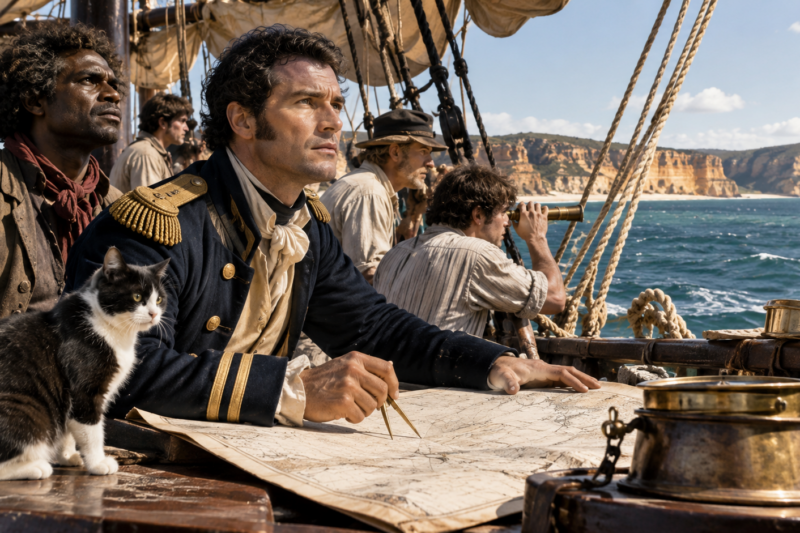
A cat named Trim.
Chapter Three: The Governor Who Named Everything After Himself
Chapter Five: The Colony Spreads