
For decades, China has dominated the supply of minerals essential to everything from electric cars to fighter jets. Now, with tensions between Beijing and Washington growing, the West is discovering the dangers of having outsourced some of its most strategically important industries.
There is something remarkable about the idea that the United States, with the world’s largest defence budget and some of the most sophisticated military technology ever developed, should depend on China for materials used in its weapons. Consider the F-35 fighter, the Tomahawk cruise missile or America’s nuclear-powered submarines. All depend, to varying degrees, on rare earth elements, some of which are essential to the powerful magnets used in electric motors, guidance systems, radar and other military equipment. And for decades, much of the supply chain for those materials has led back to China.
Now imagine a confrontation over Taiwan, or a wider conflict in the Pacific. Would Beijing really continue supplying the materials needed to manufacture weapons being used against Chinese forces or their allies? It would be foolish to expect it to. Yet this is essentially the position the United States and its allies have allowed themselves to drift into. It is a serious strategic vulnerability, made worse by the fact that the problem has been understood for decades.
The good news is that Washington is finally taking the issue seriously. The bad news is that rebuilding an industry abandoned over several decades is considerably harder than signing a government directive.
What exactly are rare earths?
Rare earths are a group of 17 metallic elements, comprising the 15 lanthanides together with scandium and yttrium. Despite their name, many are relatively abundant in the Earth’s crust. The problem is that they are rarely found in concentrations that make extraction straightforward or economical. They are also notoriously difficult to separate and refine. Unlike mining iron ore or coal, producing commercially useful rare earth materials often involves complicated chemical processes, a great deal of energy and potentially hazardous waste.
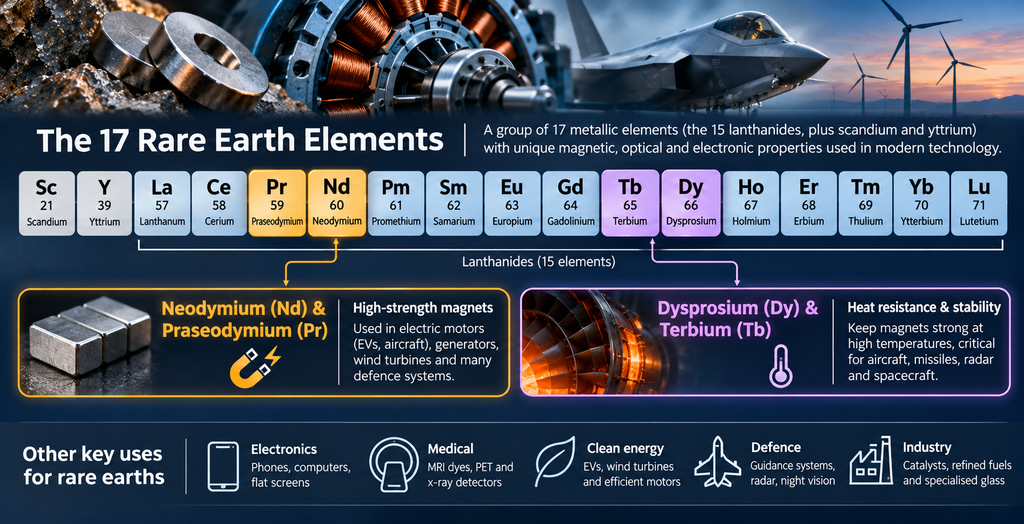
Their importance comes from their unusual magnetic, optical and electronic properties. Neodymium and praseodymium, for example, are used to manufacture powerful permanent magnets, while dysprosium and terbium help those magnets maintain their performance at high temperatures. Other rare earths are used in medical imaging, lasers, electronics, specialised glass, industrial catalysts and numerous other applications.
Not every modern technology depends on them. Conventional lithium-ion batteries, for instance, do not generally require rare earth elements, and lithium itself is not a rare earth. But for many technologies, particularly those requiring compact and powerful electric motors, rare earths are extremely difficult to replace. This is why they have become so important to both the transition towards cleaner energy and the development of modern military equipment.
How China cornered the market
China did not achieve its dominance overnight. During the Cold War, the United States was a major producer of rare earths. California’s Mountain Pass mine, which began production in 1952, was for several decades the world’s most important source. Other countries, including Australia, India, Brazil and South Africa, also possessed significant deposits.
From the 1980s onwards, however, China began aggressively expanding its rare earth industry. It had substantial mineral resources, relatively cheap labour, weaker environmental controls and a government prepared to support an industry it regarded as strategically important. Chinese producers were able to supply rare earths at prices many Western competitors struggled to match.
The results were predictable. Western production became increasingly uneconomic. Investment dried up, processing facilities closed and expertise migrated elsewhere. Mountain Pass ceased production in 2002, following years of pricing pressure and environmental problems. It has since been revived, first briefly under Molycorp, which went bankrupt in 2015 when prices fell, and now under MP Materials, but for most of two decades America had no meaningful domestic supply.
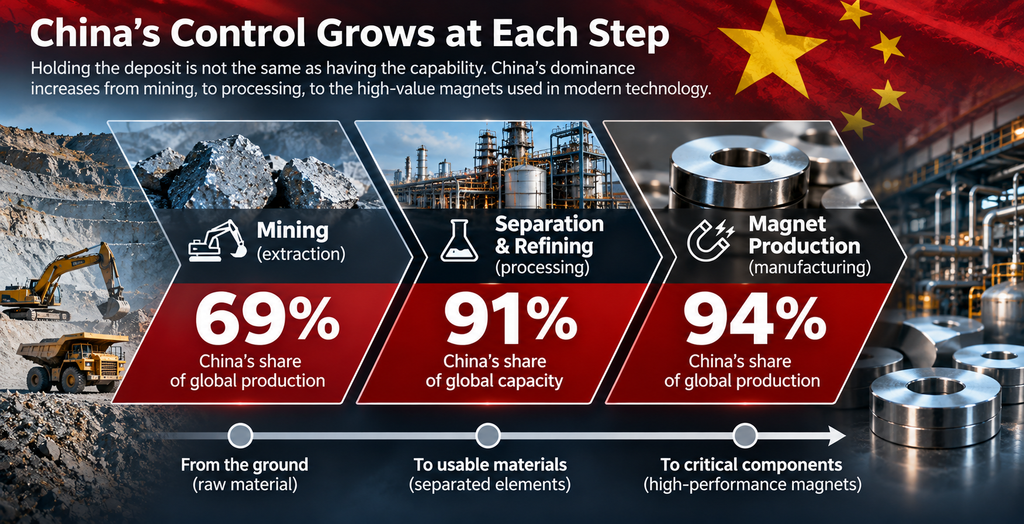
China, meanwhile, continued investing not just in mines but in the much more valuable processing and refining facilities needed to turn raw material into commercially useful products. This distinction is crucial. Having a rare earth deposit is one thing. Being able to separate its constituent elements, refine them into metals and manufacture the specialised magnets required by industry is something else entirely. China developed capabilities across this entire supply chain while much of the West became content to purchase the finished materials.
By the early 2010s, China accounted for roughly 90% or more of global rare earth mine production. Its control of processing was even more significant, and it remains so today. China’s share of mining has fallen to roughly 70% as other producers have come back online, but according to the International Energy Agency it still accounted for around 91% of separation and refining of magnet rare earths in 2024, and roughly 94% of the world’s rare earth permanent magnets.
Deng Xiaoping is widely associated with the observation, made in 1992, that the Middle East had oil while China had rare earths. Whether or not every word of that famous remark has been accurately preserved, the strategic thinking behind it is difficult to miss.
The problem with quotas
China’s dominance became a serious international concern in 2010. Following a maritime confrontation near the disputed Senkaku Islands, known in China as the Diaoyu Islands, Japan experienced a disruption in rare earth supplies from China. Beijing denied imposing a formal embargo, but the episode demonstrated just how vulnerable a major industrial economy could become when its access to essential materials depended on political relations with a single supplier.
At the same time, China was imposing export quotas and duties on rare earth products, arguing that the restrictions were necessary to conserve resources and protect the environment. There was some merit in the environmental argument; rare earth mining and refining had caused serious pollution in parts of China. However, restricting exports while maintaining access for domestic manufacturers also carried a clear industrial advantage. Foreign companies dependent on rare earths faced higher prices and uncertainty, while Chinese manufacturers enjoyed a more secure domestic supply.
In 2012, the United States, European Union and Japan challenged China’s export restrictions through the World Trade Organization. China lost the case in 2014 and removed the quotas and duties in 2015.
But the underlying problem remained. China still controlled much of the refining capacity, the technical expertise and the production of rare earth magnets, and removing a quota did not suddenly recreate the industrial capability that had disappeared from Western economies. In the years that followed, Beijing developed more sophisticated ways of managing production and exports, including domestic quotas, industry consolidation, licensing requirements and controls over processing technology.
The pricing trap
One of the most difficult problems facing potential competitors has been the volatility of rare earth prices, and it is a familiar story. China restricts supply, demand rises and prices increase. Suddenly, mining companies in Australia, the United States and elsewhere discover that deposits previously considered marginal might be commercially viable. Investors become enthusiastic, capital is raised, and new mines and processing facilities are announced. Then prices collapse. Projects that looked highly profitable become uneconomic, investors lose interest and expansion plans are delayed or abandoned.
China’s enormous production capacity gives it considerable influence over these market conditions. This does not mean every price collapse is the result of a deliberate order from Beijing. Commodity markets are complicated, and rare earths are no exception; speculation, changing demand, stockpiling and excess production have all contributed to the volatility. Nevertheless, the strategic effect is much the same. China’s low-cost supply has repeatedly made it extremely difficult for competitors to establish themselves.
This creates a genuine dilemma for Western governments. If prices are high, industry complains about costs and shortages. If prices are low, domestic producers struggle to survive. And if governments subsidise production, critics complain about interference in the free market. But a free market is difficult to maintain when one of its largest participants is backed by a state with strategic objectives extending well beyond the next quarterly profit announcement.
Australia’s Lynas and the struggle to compete
Australia has a particularly interesting role in this story. One of the few major rare earth producers operating outside China is Lynas Rare Earths, an Australian company whose Mount Weld deposit in Western Australia is regarded as one of the world’s highest-grade rare earth resources.
Lynas began developing its modern operations during the rare earth boom of the late 2000s and early 2010s. Its strategy was to mine rare earths in Australia and process them at a dedicated facility in Malaysia. The Lynas Advanced Materials Plant near Kuantan became a central part of that strategy, although its development attracted considerable controversy over environmental concerns and the management of radioactive residues.
In 2009, a proposed majority investment in Lynas by state-owned China Nonferrous Metal Mining also became politically contentious. When Australia’s Foreign Investment Review Board required the Chinese stake to be kept below 50%, the deal fell through. It was an early indication that rare earths were becoming a matter of national security rather than simply another mining investment.
Lynas subsequently faced the same problem confronting much of the industry: falling prices. The dramatic price increases of 2010 and 2011 had encouraged investment in alternative supply, but when prices retreated, the commercial environment became far more difficult. The company nonetheless survived, expanded and established itself as an important alternative to Chinese supply. Today, Lynas operates mining and processing activities in Western Australia and Malaysia, and has been developing additional capabilities to separate heavy rare earths.
Its significance goes well beyond its balance sheet. Lynas demonstrates that an alternative supply chain is possible, but also that establishing one requires enormous investment, technical expertise, patience and the ability to survive years of difficult market conditions. The question for Australia is whether companies such as Lynas should be viewed purely as commercial mining operations or as part of a wider strategic industrial capability. There is a strong argument for the latter.
From trade disputes to military confrontation
The rare earth problem has become far more serious as relations between China and the United States have deteriorated. The rivalry is no longer simply about trade deficits or the price of imported goods. It now extends across semiconductors, artificial intelligence, telecommunications, advanced manufacturing, naval power and the future of Taiwan.
Washington has imposed increasingly stringent restrictions on China’s access to advanced semiconductor technology and equipment, particularly where those technologies could support military development. Beijing regards many of these restrictions as attempts to contain China’s technological and economic rise. From China’s perspective, rare earths provide a natural counterweight. The United States may dominate parts of the advanced semiconductor supply chain, but China has enormous influence over the materials required for many modern technologies.
In 2023, Beijing introduced export controls on gallium and germanium, materials important to semiconductors and other advanced technologies, with further controls following on graphite and other critical minerals. In April 2025, China introduced export licensing requirements covering seven medium and heavy rare earth elements and related products, including dysprosium and terbium, two elements particularly important for high-performance permanent magnets.
The consequences were felt well beyond the defence industry. Automotive manufacturers, electronics companies and industrial suppliers faced delays and uncertainty, and some factories were forced to reduce production or temporarily suspend operations. A much broader set of restrictions announced in October 2025 intensified the confrontation, before a meeting between Presidents Trump and Xi at the end of that month produced a one-year suspension of the new measures. That suspension, due to lapse this month, has now been extended only until January 2027.
The April 2025 licensing system, however, remains in place. This matters. A country that must apply for permission to purchase strategically important materials does not have a secure supply chain, even if the applications are currently being approved.
Beijing’s position is not entirely irrational. Both countries increasingly view advanced technology and industrial supply chains through the lens of national security, and Washington’s restrictions on semiconductor exports rest on precisely the same logic as China’s controls on rare earths. The difference is that America spent decades allowing itself to become dependent on a potential strategic rival for materials central to its own military capability. That was a choice made in the pursuit of lower costs and commercial efficiency. It now looks short-sighted.
The Pentagon’s rare earth problem
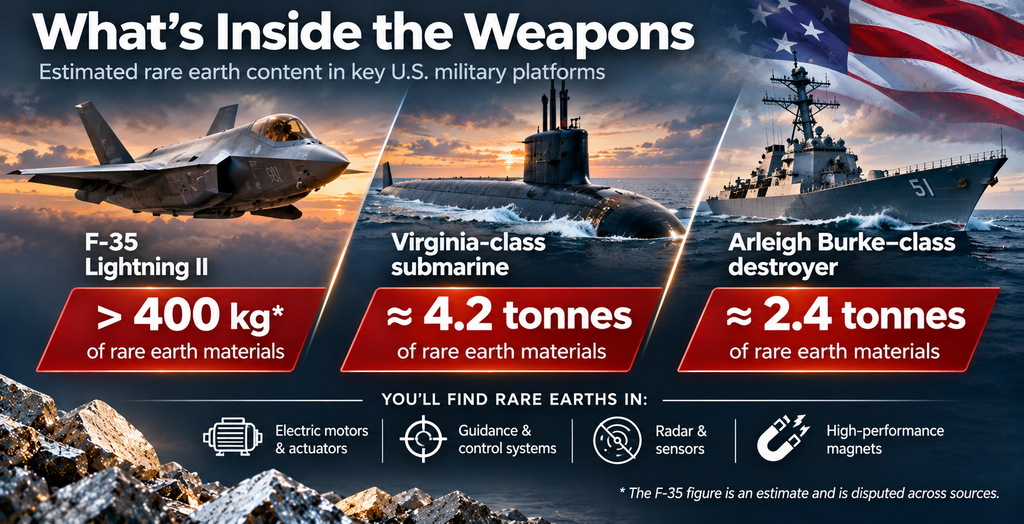
Modern military equipment depends on an enormous range of specialised materials, and rare earths are particularly important because of their use in compact, high-performance magnets and specialised electronic systems. The F-35, the Tomahawk and the Virginia-class nuclear-powered submarine all incorporate components that rely on them.
The quantities involved can be substantial. Pentagon figures, first cited in a 2013 Congressional Research Service report, put the rare earth content of each F-35 at more than 400 kilograms (around 920 pounds) and of each Virginia-class submarine at more than four tonnes. The F-35 figure has been questioned by some industry analysts because the underlying study was never published, but even a fraction of that amount would represent a significant dependency. These materials are not present as large blocks of raw metal; they are incorporated into motors, actuators, sensors, guidance systems and other components.
In peacetime, manufacturers can often manage shortages through inventories, alternative suppliers and adjustments to production schedules. In wartime, the situation is very different. A prolonged conflict consumes equipment and ammunition at rates that can overwhelm existing production capacity, and the war in Ukraine has demonstrated just how quickly modern armed forces can exhaust stocks of missiles, artillery ammunition and other sophisticated weapons. Now imagine attempting to expand production while depending on a strategic adversary for materials used in critical components. It is difficult to conceive of a more glaring supply-chain vulnerability.
And the problem extends beyond rare earths. Western defence industries face similar challenges involving explosives, propellants, specialised metals, electronic components and manufacturing capacity. The ability to design an advanced weapon is of limited value if you cannot manufacture enough of them.
America finally starts rebuilding
In November 2026, the United States Army announced an unusual initiative that illustrates just how seriously Washington is beginning to treat the problem. The Army and American rare earth company REalloys signed a non-binding term sheet setting out terms for a proposed processing facility on approximately 200 acres of the Tooele Army Depot in Utah. Under the arrangement being negotiated, REalloys would finance, build and operate a commercial facility capable of processing strategically important heavy rare earths, particularly dysprosium and terbium.
The initial lease could run for 50 years, with an option to extend it for another 25. That is a remarkable commitment: the United States Army is contemplating making military land available for a commercial processing operation for as long as 75 years. It would be the first commercial mineral processing operation ever hosted on a US military installation. The proposed arrangement would also give the Army a right of first offer to purchase material produced at the facility, although it would not be obliged to buy it.
It is worth emphasising that the project remains subject to a final agreement, financing, environmental approvals and other conditions. The plant is not yet an operating solution to America’s rare earth shortages. Nevertheless, the strategic intent is unmistakable, and the timing is no accident: from 1 January 2027, US defence procurement rules will bar rare earth magnet material mined, refined or produced in China from American weapons systems. Washington no longer appears willing to leave the production of essential defence materials entirely to the international commodity market.
REalloys is also developing processing and metallisation capabilities elsewhere in North America, including a partnership with the Saskatchewan Research Council in Canada, and has outlined plans for a broader supply chain extending from raw material through to metals and eventually magnets. This is the critical point. Opening a new mine does not solve the problem if its output must still be shipped to China for refining. The entire supply chain needs to be considered, from the mineral deposit through to the finished component. And that takes time.
A new industrial policy
The Tooele proposal is only one part of a much larger American effort. Washington has increasingly turned towards direct financial support, government purchasing commitments, strategic stockpiles and cooperation with allied countries. The objective is not necessarily to eliminate all trade with China, which would be extremely difficult and, in many cases, unnecessarily expensive. Rather, the aim is to ensure that the United States and its allies can obtain essential materials without depending on Chinese approval.
This is a significant departure from the economic thinking that dominated much of the period following the Cold War. For decades, governments assumed that globalisation and international trade would provide reliable access to almost anything industry required. If another country could produce a material more cheaply, the logical commercial decision was to buy it. That approach worked reasonably well while international relationships remained stable. It looks far less convincing in a world where major powers increasingly use trade, technology and access to resources as instruments of strategic competition.
America is now experimenting with price floors and guaranteed purchasing arrangements designed to protect domestic producers from the price collapses that have repeatedly undermined investment. The clearest example is the Pentagon’s July 2025 deal with MP Materials, the owner of Mountain Pass, under which the Defense Department became the company’s largest shareholder and guaranteed a price of US$110 per kilogram for its neodymium-praseodymium output for ten years, nearly double the prevailing Chinese price at the time.
Such measures are expensive, and they carry their own risks. Governments can back the wrong companies, encourage inefficient production and create industries dependent on subsidies. But there is an equally significant cost in having no domestic production at all. For strategically important materials, the cheapest supplier is not always the most secure supplier.
The environmental dilemma
There is another uncomfortable aspect to the rare earth story. Many of these materials are essential to technologies intended to reduce carbon emissions; electric vehicles, wind turbines and other clean energy systems often depend on rare earth magnets. Yet producing rare earths can cause substantial environmental damage if mining and refining are poorly managed. Waste streams may contain radioactive materials, while separation and refining can require hazardous chemicals and produce contaminated residues.
China’s early dominance was assisted in part by environmental standards and operating costs that Western producers could not easily match. Rebuilding the industry in Australia, the United States and elsewhere will require dealing with those environmental costs rather than simply shifting them out of sight. This is not an argument against developing alternative supplies. Quite the opposite: it is an argument for recognising the true cost of production, including environmental protection, waste management and the strategic value of secure supply.
Recycling also has an important role to play, particularly as growing quantities of electric motors, electronics and industrial equipment reach the end of their useful lives. Research into alternative magnet materials and more efficient manufacturing techniques may eventually reduce demand for some rare earth elements. However, neither recycling nor substitution is likely to eliminate the need for substantial primary production in the foreseeable future.
What does this mean for Australia?
Australia is unusually well placed to benefit from the restructuring of global rare earth supply chains. We possess significant mineral resources, established mining expertise, relatively stable political institutions and close strategic relationships with the United States, Japan and other major industrial economies.
But we also face a familiar problem. For decades, Australia’s economic model has been built around extracting raw materials and exporting them for processing elsewhere. That has generated enormous wealth, particularly through iron ore and coal. Rare earths present an opportunity to do something more. Instead of simply digging material out of the ground, Australia could expand its role in refining, metal production and the manufacture of higher-value components. Lynas has already demonstrated that such a model can work, although not without considerable difficulty.
The challenge is ensuring that new investment survives the inevitable fluctuations in commodity prices. This may require long-term purchasing commitments from governments and industrial customers, rather than leaving producers exposed entirely to short-term market conditions. There is also an opportunity for closer integration with American and Japanese defence and industrial supply chains. If the United States is determined to reduce its dependence on Chinese materials, Australia is a natural partner.
However, we should be realistic about the scale of the task. China has spent decades building its expertise, facilities and industrial relationships, and Australia and its partners cannot replicate that capability overnight. Nor should we assume that Beijing will simply stand aside while competitors establish alternative supply chains. China can compete on price, expand production, invest in overseas projects and use its considerable influence over existing markets. The next decade is likely to see an increasingly intense contest over who controls not merely the minerals themselves, but the industrial processes required to turn them into useful products.
The price of dependence
When I first wrote about rare earths more than a decade ago, the central concern was China’s dominance of supply and Beijing’s ability to influence prices and exports. Those concerns have not disappeared; they have become far more important. What was once primarily an economic and industrial issue has become a question of national security.
The United States is now confronting the consequences of decades in which commercial efficiency took precedence over strategic resilience. China, meanwhile, has every reason to regard its rare earth industry as a national asset. It would be naive to expect Beijing to surrender that advantage voluntarily, particularly while Washington is restricting China’s access to advanced technologies. And it would be even more naive to expect China to guarantee the supply of materials required to manufacture weapons that might one day be used against it.
The proposed American rare earth facility at Tooele Army Depot is therefore significant, not because one processing plant will suddenly break China’s dominance, but because it represents a change in thinking. The Pentagon is beginning to treat the production of critical materials as part of its military capability, rather than something that can safely be left to the lowest bidder. Australia has an opportunity to play an important role in that shift.
The real question is whether Western governments have the patience to support alternative supply chains through the next inevitable collapse in rare earth prices. China has already demonstrated that it can play a very long game. The West has spent far too much time thinking about the next quarter.