
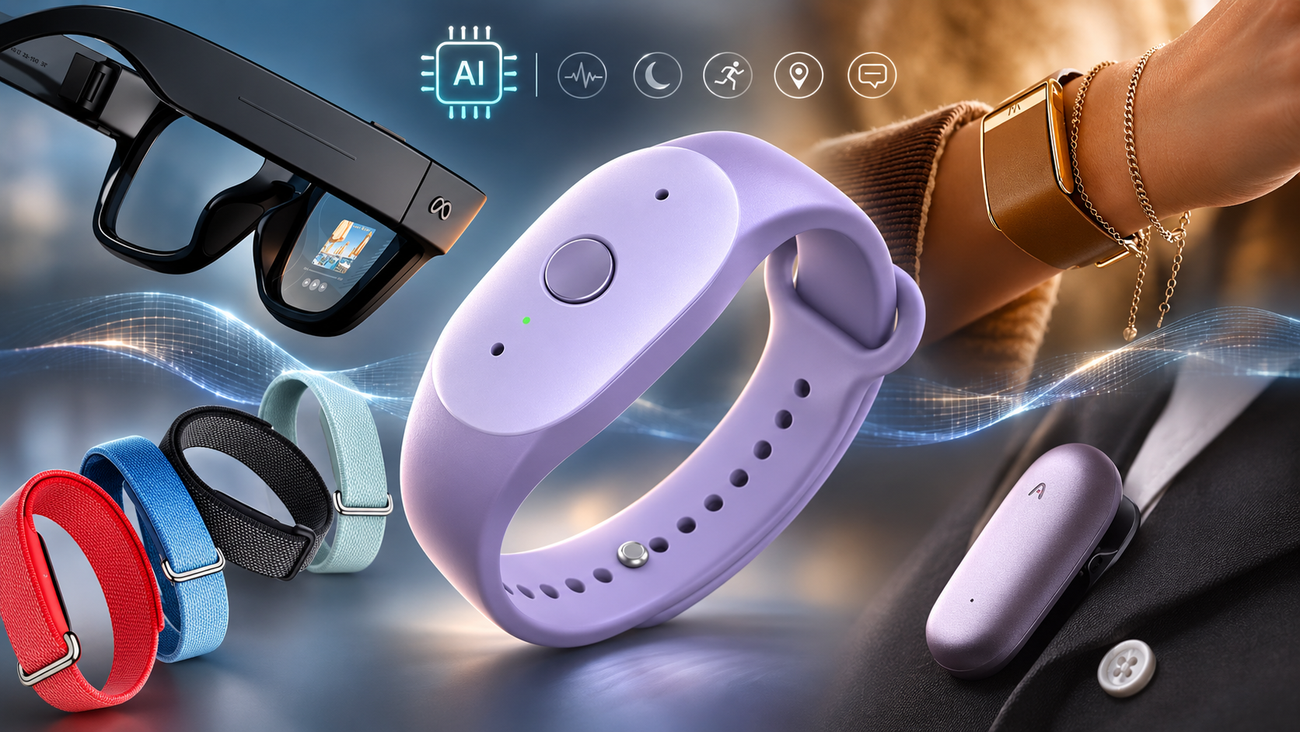
Artificial intelligence is escaping the smartphone and finding a new home on our wrists. From bands that remember conversations to bracelets that control computers through tiny muscle movements, the humble wristband is getting a rather serious upgrade.
For most of us, a bracelet is either jewellery or something that counts our steps. Perhaps it monitors our heart rate, tells us we slept badly or reminds us that we haven’t moved for the past hour.
A new generation of AI-powered wristbands promises to do a great deal more.
Imagine a bracelet that remembers the details of a conversation you had three weeks ago. Or one that lets you control a computer simply by moving your fingers. Some even promise to become personal assistants, quietly building a picture of your daily life and helping you manage it.
It sounds like science fiction, but several of these devices are already on sale.
The interesting question isn’t whether we can build them. We clearly can. It’s whether we really want to wear them.
What exactly is an AI bracelet?
An AI bracelet is a wearable device that uses artificial intelligence to interpret information collected from sensors, microphones or other inputs.
A traditional fitness tracker mainly measures physical activity. An AI bracelet might record conversations, recognise gestures, organise information or offer personalised advice.
Not all the intelligence necessarily lives in the bracelet itself. In many cases, the device simply collects information and sends it to a smartphone or a cloud-based AI service for processing.
That distinction matters. A bracelet might look like a remarkable piece of miniature computing, but the real intelligence could be running on a server thousands of kilometres away.
Several distinct approaches are emerging, and some are considerably more interesting than others.
The bracelet that remembers everything
One of the most intriguing developments is the AI memory bracelet. The concept is simple. Wear a small microphone-equipped band throughout your day and let artificial intelligence turn your conversations into useful information.
Forgot what your accountant said about that tax deduction? Can’t remember the name of the restaurant someone recommended? Or perhaps you had a brilliant idea while walking down the street and promptly forgot it. Your AI bracelet may be able to help.
In July 2025, Amazon bought a startup called Bee, which made a US$50 wristband that listened to conversations and turned them into summaries, reminders and to-do lists. In October 2026, Amazon released its first Bee devices under its own ownership: the Bee Frontier, a lighter, water-resistant wristband for US$52.49, and the Bee Eclipse, which clips magnetically to the back of a phone. The basic service is free, but the more useful features, unlimited summaries, Alexa+ integration and links to your email and calendar, sit behind a Bee Pro subscription of US$11.99 a month.
Rather than manually recording a meeting or taking notes, the idea is that the system quietly builds a record of your day. It’s worth noting that Bee Frontier is currently sold only in the United States.
Other companies have taken a similar path. Plaud’s NotePin (from US$126.99) is a small capsule-shaped recorder that can be worn as a pendant, clipped to a shirt or strapped to your wrist. Unlike Bee, it records only when you press the button, which some people may find rather more comfortable. There is something undeniably attractive about having a second memory.
Most of us forget far more than we remember. Conversations disappear, names escape us and useful information gets buried under the daily avalanche of emails, messages and meetings. An assistant that could retrieve these details when you simply ask would be genuinely useful. But it also introduces an awkward problem.
What happens when the person you’re talking to doesn’t want to be remembered?
The bracelet that reads your muscles
If AI memory bracelets sound clever, the Meta Neural Band is arguably more impressive. Developed by Meta’s Reality Labs, the Neural Band uses a technology called surface electromyography, or sEMG. It measures the tiny electrical signals produced by your muscles when you move your fingers and hands.
Artificial intelligence interprets those signals and converts them into commands. A small finger movement might select an item on a screen. Another gesture could scroll through a menu. No keyboard, mouse or touchscreen required.
The band is sold with Meta Ray-Ban Display smart glasses, which include a small display built into one lens. The package was released in the United States in September 2025 for US$799 (not available as of mid November), with the band included. Local availability has been slow to arrive, so check Meta’s Australian store before getting too excited.
What’s remarkable is how subtle the muscle activity can be. Some movements are barely visible to anyone watching. To be clear, it isn’t reading your thoughts. It’s interpreting electrical signals generated by your muscles.
That said, the distinction may matter less to the person using it. Imagine sitting on a train, reading information displayed inside your glasses and controlling it through tiny movements of your fingers. No phone. No keyboard. No obvious interaction with a computer at all. There are also potentially important applications for people with disabilities, particularly those who struggle with conventional input devices.
For years, technology companies have tried to make computers more natural to use. Voice assistants were one approach. Touchscreens were another. The Neural Band suggests the next interface might be our own muscles.
Your personal health adviser
The fitness industry has been collecting information about our bodies for years. Heart rate, sleep, movement, skin temperature and recovery indicators are already familiar features of modern wearables.
Artificial intelligence adds another layer. Instead of simply displaying numbers, the software attempts to interpret them. A conventional fitness tracker might tell you that you slept for six hours and forty minutes.
An AI-powered system might look at several weeks of sleep, activity and recovery data and suggest that your late evening workouts are affecting your sleep. It might recommend a lighter session, an earlier bedtime or a change to your routine.
2026 has been the year of the screenless health band. Whoop pioneered the idea and pairs its band with an AI coach, though it only works with a paid membership. Google followed with the Fitbit Air (A$199), whose Gemini-powered coach is part of a Google Health Premium subscription at A$14.99 a month. Garmin’s CIRQA (US$199.99) takes the opposite approach, with no subscription at all.
This kind of advice can be genuinely useful, particularly when it’s based on patterns that aren’t immediately obvious. But there are limitations. Consumer wearables don’t become medical diagnostic instruments just because their marketing departments have discovered artificial intelligence. A device can make a reasonable estimate of your sleep or activity without understanding the underlying medical causes.
There’s also a danger that people begin treating AI-generated health advice as a substitute for seeing a doctor. The sensible approach is to regard these devices as useful sources of information, not miniature doctors strapped to your wrist.
The AI companion on your wrist
Another emerging category is the AI companion or assistant bracelet. These devices give you access to a conversational AI without taking out your phone. Some use a button or microphone to wake a chatbot. Others are meant to provide reminders, encouragement or conversation throughout the day.
The ambition is to make artificial intelligence feel less like software and more like a constant companion. That may appeal to some people, particularly those who enjoy experimenting with new technology.
However, I suspect the real value will come when these devices become genuinely useful rather than merely chatty. The AGENT Band (US$179 on pre-order, due to ship in December 2026) is an interesting test case. It’s a screenless wristband that you talk to, and its assistant then tries to make calls, book appointments and send messages on your behalf, checking with you before it acts. Whether it can do that reliably remains to be seen.
A bracelet that tells me an encouraging story is a novelty. One that remembers what I need to buy, knows when I’m running late, reminds me about an important conversation and helps organise my day is something else entirely. The difference is between a gadget that talks and an assistant that actually assists.
How do these devices work?
Despite their different functions, most AI bracelets follow a similar pattern.
First, sensors collect information. These might include microphones, motion sensors, optical heart-rate monitors or electrodes that measure muscle activity.
Second, the information is processed. Some processing happens on the device, but more demanding tasks usually rely on a connected smartphone or cloud service.
Finally, the results are presented to you through an app, an audio response, a notification or another connected device.
This lets manufacturers build small, lightweight devices without squeezing a powerful computer onto your wrist. However, it also means some products depend heavily on an internet connection, a subscription and the continuing support of the manufacturer.
If the company disappears or decides to discontinue its service, the clever bracelet on your wrist could quickly become an expensive piece of plastic.
The privacy problem nobody can ignore
This is where things get particularly interesting. A fitness tracker knows how many steps you’ve taken. An AI memory bracelet could know what you said, who you spoke to, where you were and what you were planning.
Over time, that could add up to an extraordinarily detailed picture of your life. Your relationships, business discussions, personal worries, financial decisions and private conversations could all become part of a searchable digital history.
And unlike a personal diary, that history may be stored on infrastructure operated by a technology company. Before buying one of these devices, it’s worth asking:
- Does it record continuously, or only when activated?
- Are the original audio recordings kept or deleted after transcription?
- Can the company use your information to train its AI models?
- Where is the information stored, and who can access it?
- Can you permanently delete your history?
- What happens to your data if the company is sold or closes?
There’s also the matter of recording other people.
In Australia, surveillance and listening-device laws vary between states and territories. Depending on the circumstances, recording a private conversation without appropriate consent may be unlawful. And even where a recording is legal, that doesn’t necessarily make it socially acceptable.
Imagine attending a family dinner and discovering that one of your relatives has been quietly recording the entire evening for their AI assistant. I suspect the conversation might become rather less friendly.
Workplaces present another problem. Confidential commercial discussions, client information and internal meetings are not necessarily appropriate material for an employee’s personal AI system. The technology may be impressive, but the social rules around it are still catching up.
Are AI bracelets worth buying?
That depends on what you expect them to do. If you spend much of your day in meetings, an AI recording device could be extremely useful. Automatic notes, searchable transcripts and reminders might save hours of administrative work.
If you’re interested in where computer interfaces are heading, Meta’s Neural Band offers a glimpse of a potentially important shift. Health-focused bands can provide useful insights into fitness and recovery, although the quality of those insights varies considerably.
AI companion bracelets are harder to assess. Many are still early products, and their long-term usefulness remains uncertain. Then there are the familiar problems with any wearable: battery life, comfort, durability, subscription costs and whether the device stays useful once the novelty wears off.
A bracelet that needs charging every night, regularly loses its connection and demands yet another monthly subscription may be less appealing than its advertising suggests.
What happens next?
The most interesting possibility is that these different technologies eventually converge. Imagine a single lightweight wristband that recognises gestures, monitors your health and works with a personal AI assistant.
Combine that with smart glasses, wireless earphones and a system that understands your schedule, preferences and daily activities. You start to get something quite different from today’s smartwatch.
Instead of constantly opening apps and typing in information, your digital assistant could become a largely invisible part of everyday life. It might remember the important details of conversations, respond to subtle gestures and offer useful information at the moment you need it.
The benefits are obvious, particularly for accessibility, productivity and personal organisation. But there’s also a rather uncomfortable possibility.
We’ve spent the past twenty years letting smartphones take up an ever larger part of our lives. AI wearables promise to make that technology even more intimate. The smartphone sits in your pocket. The AI bracelet sits against your skin, potentially listening, learning and interpreting your behaviour throughout the day.
Whether that’s progress or simply another surrender of personal privacy will depend on how the technology develops and how much control we, as users, keep.
The real breakthrough won’t be a bracelet that knows everything about us. It will be one that knows enough to be useful, without making us regret wearing it.
Products mentioned
Prices as at November 2026, in US dollars unless noted. Availability in Australia varies.
| Product | What it does | Price |
|---|---|---|
| Amazon Bee Frontier | Wristband that records conversations and turns them into summaries and to-dos | US$52.49 + optional Bee Pro (US$11.99/month) |
| Plaud NotePin | Push-to-record AI note-taker, wearable on the wrist, as a pendant or as a clip | From US$159 |
| Meta Ray-Ban Display + Neural Band | Display glasses controlled by a muscle-sensing (sEMG) wristband | US$799 |
| Google Fitbit Air | Screenless health band with a Gemini-powered AI coach | A$199 + optional Google Health Premium (A$14.99/month) |
| Whoop | Screenless recovery and fitness band with AI coaching | Membership only |
| Garmin CIRQA | Screenless health band, no subscription required | US$199.99 |
| Persona Band | Voice-driven AI assistant wristband that carries out tasks for you | US$179 (pre-order) |