Lachlan Macquarie, his convicts and the beginnings of a nation
If you spend any time in New South Wales, you will notice a name that keeps coming up. Macquarie Street. Macquarie Place. Macquarie University. Port Macquarie. Lake Macquarie. The Macquarie River. Macquarie Lighthouse. Mrs Macquarie’s Chair. There is also a Macquarie Bank and even a Macquarie Island, halfway to Antarctica.
All of them trace back to one man: Lachlan Macquarie, Governor of New South Wales from 1810 to 1821. He was not shy about naming things after himself. Although, to be fair, quite a few were named in his honour by other people. And he did build an awful lot of things.
A Fresh Start
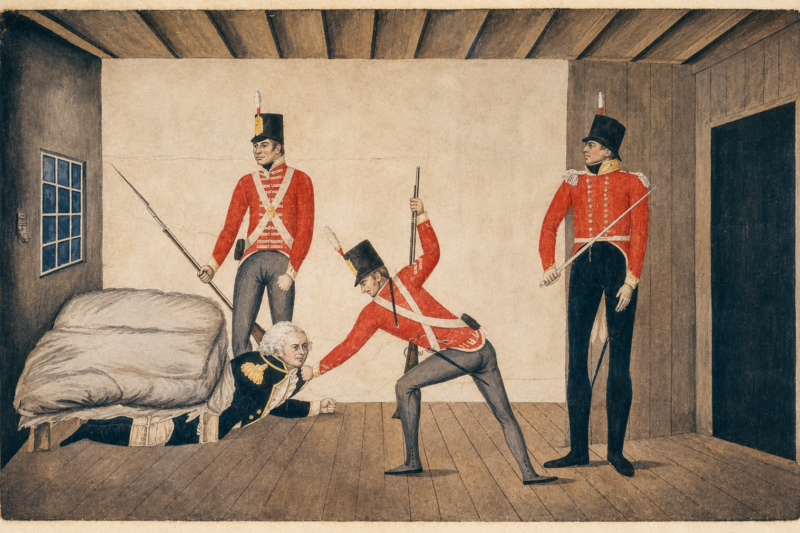
On 1 January 1810, Lachlan Macquarie took office as Governor of New South Wales. He arrived to find a colony that had recently overthrown its previous governor, William Bligh, and spent nearly two years under military rule. Not exactly an encouraging start.
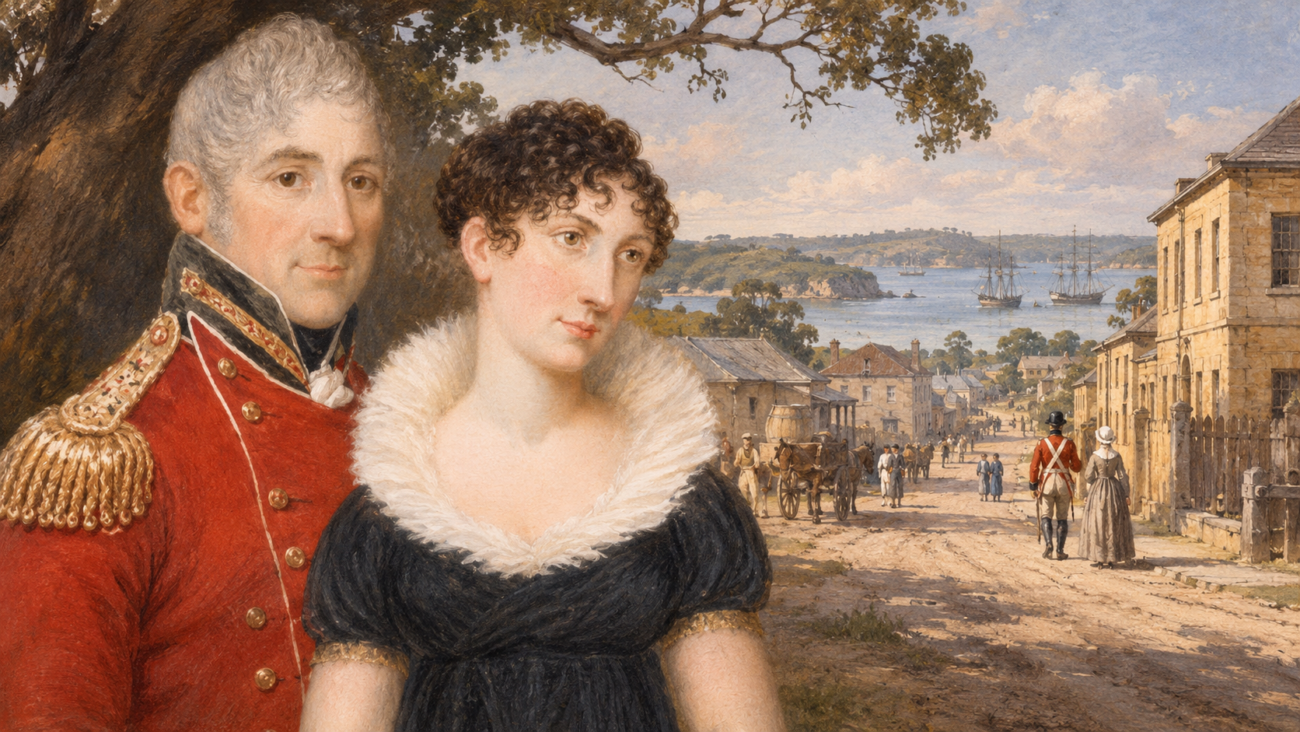
Macquarie was a Scottish army officer who had served in North America, India and Egypt. He arrived with his wife, Elizabeth, and the 73rd Regiment of Foot, which replaced the troublesome New South Wales Corps. London expected him to restore order. He did that, and then rather more.
Macquarie looked at Sydney, a scruffy collection of huts, tracks, warehouses and government buildings around the harbour, and decided it should look like a proper town. So he started building one. He also brought something that had been in rather short supply during the colony’s first twenty years. A plan.
A Governor in a Hurry
Macquarie wasted little time imposing some order on Sydney’s streets. He formalised street names, including George Street, previously known as High Street, and set aside Hyde Park as a public recreation ground.
Out on the Hawkesbury River, where farms kept getting washed away by floods, he established five new towns on higher ground: Windsor, Richmond, Wilberforce, Pitt Town and Castlereagh. They are still known as the Macquarie Towns.
Then came roads, bridges, churches, barracks, a lighthouse, a hospital, schools and public squares. Macquarie had an enthusiasm for public works that would have made a modern infrastructure minister positively envious. And unlike many modern infrastructure ministers, he generally got things built.
In 1813, Gregory Blaxland, William Lawson and William Charles Wentworth found a practical route across the Blue Mountains, which had blocked the colony’s westward expansion for twenty-five years. Macquarie wasted no time. In 1814 he sent William Cox and a working party of convicts and soldiers to build a road across the mountains. They completed roughly 160 kilometres of road in about six months.
It was a remarkable achievement, particularly considering the terrain and the equipment available. In 1815, Macquarie travelled over the new road himself and established Bathurst, the first European inland town in Australia. The mountains were no longer an effective barrier to colonial settlement. And the colony was beginning to expand beyond its original coastal settlements.
In 1817, the Bank of New South Wales opened in Sydney, becoming Australia’s first bank. It is still around today, although under a different name. Westpac.
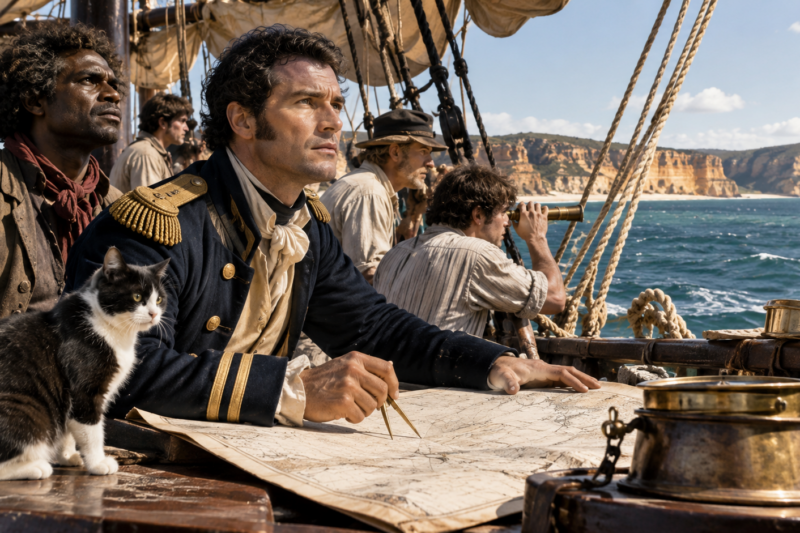
That same year, Macquarie began using the name Australia in his official correspondence with London, following the suggestion of the explorer Matthew Flinders. He recommended that the name be formally adopted. It would take some time before it became universal, but the name was beginning to stick. Australia. Rather a good choice, really.
Mrs Macquarie
Macquarie’s wife, Elizabeth, deserves some credit for the transformation of Sydney. Born Elizabeth Campbell, she married Lachlan in 1807 and accompanied him to New South Wales.
She was intelligent, interested in architecture and landscaping, and enthusiastic about improving the appearance of the colony. Elizabeth took a particular interest in the design of public buildings and gardens, and encouraged her husband’s ambitious building program.
She was also associated with the development of the Government Domain, the extensive grounds surrounding Government House.
One of her favourite places was a rocky point overlooking Sydney Harbour. In 1810, convicts carved a sandstone seat there, which became known as Mrs Macquarie’s Chair. It remains one of Sydney’s best-known landmarks. The view today takes in the Harbour Bridge, Opera House and the city skyline.
In Elizabeth’s time, the scene was very different. There were sailing ships, wooded headlands, a scattering of colonial buildings and a harbour that still looked much as it had when the First Fleet arrived. She could hardly have imagined what the city would become. Although, judging by her husband’s enthusiasm for building things, she might have had some idea.
Macquarie’s Convicts
What made Macquarie unusual was not simply what he built. It was who he relied on to do it. Macquarie believed that once convicts had served their sentences, they deserved a genuine second chance.
These former convicts were known as emancipists. He gave them land, employment and positions of responsibility. He even invited some to dine at Government House. The colony’s wealthy free settlers, often called the exclusives, were appalled. They believed that a convict’s past should permanently determine his place in society.
Macquarie disagreed. He believed that people who had completed their punishment and demonstrated their ability should be allowed to contribute to the colony. And some of them turned out to be remarkably talented.
Among those Macquarie supported were a convicted forger, a naval mutineer and a counterfeiter. Between them, they would help design Sydney, improve the health of its inhabitants and produce Australia’s first locally made coins. Not a bad collection of criminals.
The Forger Who Designed Sydney
Francis Greenway was an architect from Bristol who had been convicted of forgery. He was sentenced to death, but the sentence was commuted to fourteen years’ transportation. He arrived in Sydney in 1814. Greenway was talented, ambitious and, by most accounts, extremely difficult to work with. Macquarie made him the colony’s Civil Architect anyway.
One of Greenway’s first major commissions was a lighthouse at South Head, guarding the entrance to Sydney Harbour. Macquarie was so impressed with the work that he granted Greenway a conditional pardon in 1817. The lighthouse was completed the following year. Naturally, it was called Macquarie Lighthouse.
Greenway went on to design some of Sydney’s finest colonial buildings, including St James’ Church and the Hyde Park Barracks. The barracks, completed in 1819, provided accommodation for male convicts working on government projects.
Before then, many convicts had been left to find their own accommodation in the town, an arrangement that was hardly ideal for maintaining discipline. Greenway’s barracks helped bring the system under greater government control.
Macquarie granted him a full pardon in 1819. Greenway later fell out with his patron, and his career declined after Macquarie left the colony. But his buildings survived. And in 1966, when Australia introduced decimal currency, Francis Greenway appeared on the first ten-dollar note. A convicted forger on the money. Only in Australia.
The Mutineer Who Became the Colony’s Doctor
William Redfern was a young naval surgeon’s mate aboard HMS Standard when its crew became involved in the Nore mutiny of 1797. This was the same widespread naval revolt in which William Bligh, then commanding HMS Director, had also been caught up. Redfern was court-martialled and sentenced to death for his involvement. Fortunately for him, the sentence was commuted, and he was transported to New South Wales.
He initially worked as a medical practitioner on Norfolk Island, where his abilities quickly became apparent. Eventually pardoned, he established himself as one of the colony’s most respected doctors. Macquarie recognised his talents and appointed him to important medical responsibilities. Redfern became the governor’s family doctor and later a magistrate. But his greatest contribution may have been to the treatment of convicts transported from Britain.
Conditions aboard convict ships could be appalling. Overcrowding, poor sanitation, disease and inadequate food had caused terrible suffering and many deaths. Redfern investigated the problem and prepared a report recommending improvements to medical supervision, hygiene and conditions during the voyage.
His recommendations helped influence reforms, including the more systematic appointment of naval surgeons to convict transports. The changes helped make transportation considerably safer. Redfern had arrived in Australia as a convicted mutineer. He became a doctor whose work helped save the lives of other convicts.
When his son was born, Redfern named him William Lachlan Macquarie Redfern. A fairly clear indication of what he thought of the governor. The Sydney suburb of Redfern takes its name from him.
The Counterfeiter Who Made the Money
Then there was William Henshall. Henshall had been transported to New South Wales for counterfeiting. As it turned out, this made him rather useful. Because the colony had a problem. It didn’t have enough money.
The Rum Hospital
Before we get to Henshall’s remarkable contribution, there is another of Macquarie’s building projects worth mentioning. Sydney needed a proper hospital. The existing medical facilities were inadequate, and the colony’s population was growing.
Macquarie wanted a substantial new building. London wasn’t particularly enthusiastic about paying for one. So Macquarie came up with a very colonial solution. He made a deal with three businessmen: Garnham Blaxcell, Alexander Riley and D’Arcy Wentworth.
They would build the hospital at their own expense. In return, they would receive valuable rights to import and sell a large quantity of spirits. The arrangement was effectively a public-private partnership financed by rum. Sydney promptly nicknamed it the Rum Hospital.
The hospital was completed in 1816. Not long afterwards, Francis Greenway inspected the building and was highly critical of its construction, raising concerns about its quality and structural soundness. The hospital nevertheless remained standing. Two of its original wings survive today. One forms part of NSW Parliament House. The other became the Sydney Mint.
So even after the Rum Rebellion, Macquarie was still using rum to get things done. Apparently, the trick was to make sure the government got a hospital out of it.
Fun Fact: Australia’s First Coin Had a Hole in It
Early New South Wales had a serious money problem. There were never enough coins. Ships arriving in Sydney took the colony’s coins away again as payment for imported goods, leaving the inhabitants trading in rum, promissory notes and whatever foreign currency happened to be available.
So in 1812 Macquarie arranged for the importation of 40,000 Spanish silver dollars, commonly known as pieces of eight. He then had a rather clever idea. He would turn each coin into two.
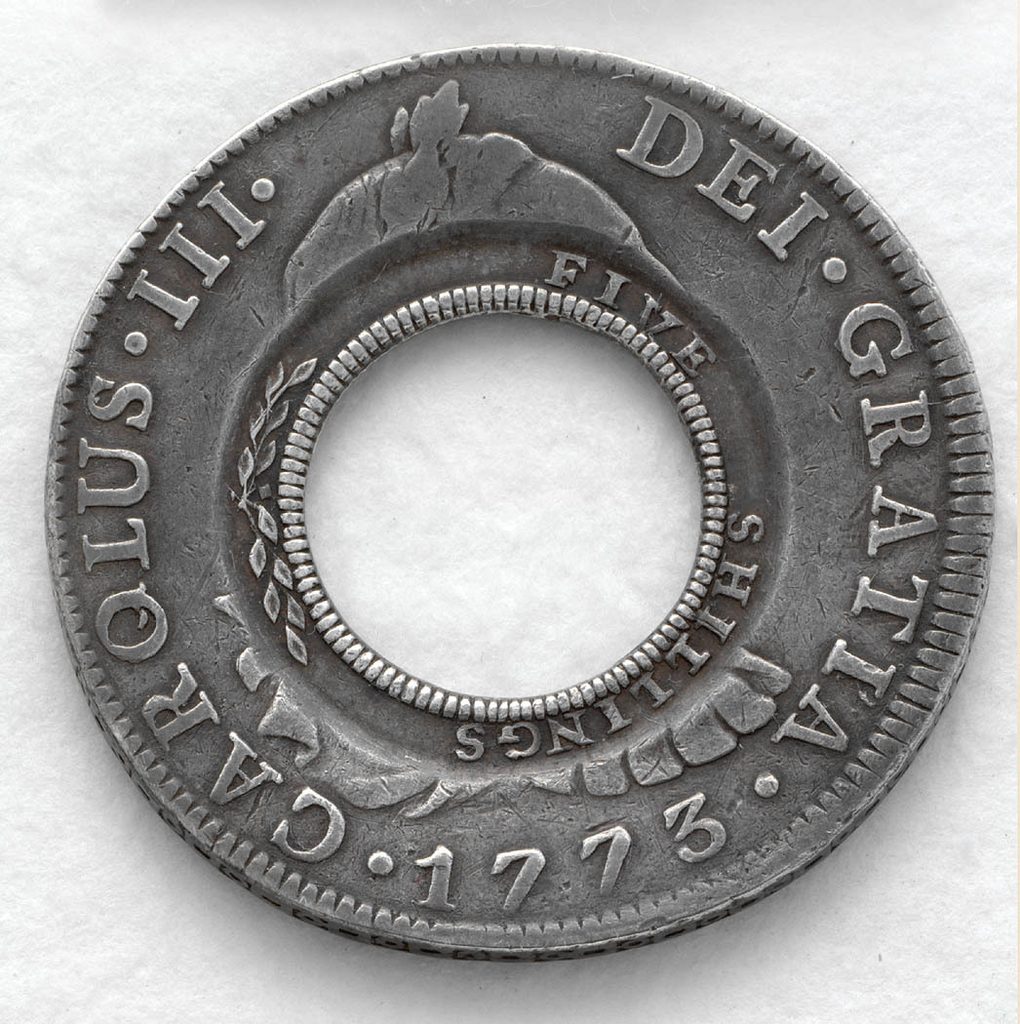
A New South Wales “holey dollar”, the first distinct currency of Australia – By State Library of New South Wales
The centre of every dollar was punched out, leaving a silver ring and a small circular disc. The outer ring was stamped with the words New South Wales 1813 and given a value of five shillings. It became known as the holey dollar. The small disc from the centre was stamped with a crown and valued at fifteen pence. It became known as the dump.
Together, the two pieces were worth more than the original Spanish dollar. This helped discourage people from taking the coins out of the colony, while providing New South Wales with a much-needed supply of currency.
And the man chosen to do the work? William Henshall. A convicted counterfeiter. Macquarie needed somebody who knew how to work with coins. As it happened, the colony already had one. Henshall even incorporated a small letter H into the design of the dump.
The coins entered circulation in 1813 and were gradually withdrawn during the 1820s. Most were eventually melted down. oday, surviving holey dollars and dumps are highly prized by collectors, with particularly rare examples selling for hundreds of thousands of dollars.
And if you have ever wondered why Macquarie Bank’s logo features a circle with a hole in it, now you know. It was inspired by the holey dollar. Australia’s first locally produced currency had been made by a man transported for making illegal money. You have to admire the efficiency.
Not Everyone Benefited
Macquarie’s building program and his support for former convicts helped transform colonial New South Wales. But the colony’s expansion came at a terrible cost to many Aboriginal communities.
The new roads and settlements pushed European farming and grazing further into lands already occupied by Aboriginal peoples. Conflict increased as settlers occupied land, disrupted access to food and water, and sought to impose their own laws.
On the Cumberland Plain and beyond, violence between settlers and Aboriginal groups became increasingly serious. In 1816, Macquarie ordered military expeditions against Aboriginal people in districts surrounding Sydney.
The operations resulted in deaths, including the killing of Aboriginal men, women and children near Appin. For Aboriginal communities, the governor remembered for roads, towns and public buildings was also responsible for military violence and the expansion of settlement onto their lands.
It is an important part of the story. The colony was becoming more prosperous and better organised. But not everyone was sharing in that prosperity.
The End of Macquarie’s Sydney
Not everybody approved of Macquarie’s administration. The colony’s wealthy exclusives complained to London that he was spending too much money and treating former convicts far too kindly. They believed he was undermining the distinction between respectable free settlers and people who had arrived as criminals.
Back in Britain, there was also growing concern that New South Wales was becoming too comfortable. After all, transportation was supposed to be a punishment. If former convicts could acquire land, become wealthy and dine with the governor, what sort of deterrent was that?
In 1819, the British government sent a commissioner named John Thomas Bigge to investigate the colony. Bigge examined Macquarie’s administration, the convict system, government spending and the colony’s economic development.
His reports were critical of several aspects of Macquarie’s policies, particularly the expense of public works and his support for emancipists. Macquarie had already sought permission to retire, and his departure brought an end to an extraordinary period in the colony’s development.
He handed over government to Sir Thomas Brisbane in December 1821 and sailed for Britain in February 1822. He died in London in 1824. Macquarie was buried on the Scottish island of Mull. His tomb bears the inscription:
The Father of Australia.
It is the sort of title he probably would have chosen himself. Then again, it is hard to argue that he hadn’t made a substantial contribution.
If You Remember One Thing…
Macquarie arrived in a colony that had recently overthrown its governor. He left behind one with roads, towns, churches, a bank, a hospital, its own coins and a route across the mountains. He helped turn Sydney from a rough penal settlement into a more organised colonial town.
And he achieved much of it with the help of former convicts: forgers, mutineers and counterfeiters who were given a second chance and turned out to be rather good at their jobs.
There was a darker side to the expansion of the colony, particularly for the Aboriginal people whose lands were being occupied. But Macquarie’s belief that a person’s past should not necessarily determine their future was an important departure from the rigid social divisions of the British society he represented. It was an idea that would continue to influence the Australian story.
Visit It Today
One of the wonderful things about Macquarie’s Sydney is how much of it you can still see. Start at the Hyde Park Barracks on Macquarie Street. Designed by Francis Greenway, it is now a museum and part of the World Heritage-listed Australian Convict Sites. Nearby are the Sydney Mint and NSW Parliament House, the two surviving wings of the old Rum Hospital. Across the road stands Greenway’s St James’ Church, still in use today.
Continue through the Royal Botanic Garden towards Mrs Macquarie’s Chair, where Elizabeth Macquarie once enjoyed the harbour views. The sandstone seat remains, although the view has changed somewhat. For a longer excursion, head to Macquarie Lighthouse at South Head, in Vaucluse. Greenway’s original lighthouse was replaced in the 1880s, but the new tower closely follows his design.
If you are feeling particularly adventurous, you can also visit the five Macquarie Towns along the Hawkesbury River, or follow the old route across the Blue Mountains towards Bathurst. And to see a genuine holey dollar, visit the National Museum of Australia in Canberra or one of the museums holding examples of the colony’s first locally produced currency. Meanwhile, out at Parramatta, Elizabeth Macarthur had been quietly getting on with the sheep.
And that is our next story.
Chapter Two: The Rum Rebellion, A Very Australian Coup
Chapter Four: Riding on the Sheep’s Back, the birth of Australia’s wool industry