
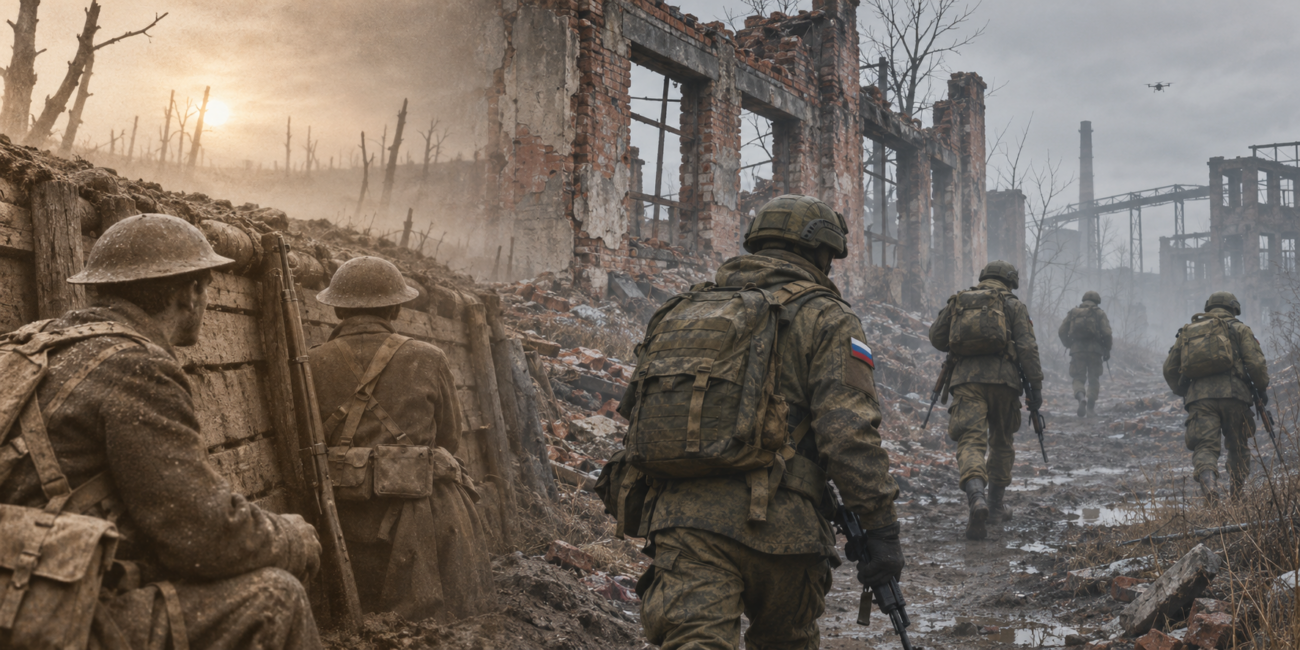
In the early 1990s I spent three years as a trainee with the Sydney University Regiment. My rank was Officer Cadet (OCDT). Vietnam was still very much with us, from our SLRs to the jungle green field dress we all wore. Our platoon, and to some extent company training, drew heavily on what the Australian Army believed it had done well there. We learnt to patrol aggressively, move quietly and know our weapons. Aggression and stealth sound like an odd pairing until you consider what a patrol was for. You wanted to find out who was out there. Ideally, you wanted to find out first, but if you were surprised, instant fire and movement was king.
I’ve spent a fair bit of time watching footage from both sides of the war in Ukraine, and what strikes me is how much of the infantryman’s job I still recognise. Small groups of infantry move across contested ground, looking for an enemy who is in turn looking for them. What has changed is how that observation happens, and its scale. Now the soldier who spots you may be hidden in a dugout many kilometres behind the front, watching your heat signature move across a screen. And the moment you’re most exposed may come long after the fighting, when somebody has to bring you water or carry you out.
The few soldiers you can see
During the Vietnam War, Australian troops earned a solid reputation for aggressive patrolling. But the popular image of the self-reliant Australian infantryman leaves quite a few people out of the picture. The Australians firmly embraced the concept of combined arms. Being able to call in air and artillery support, or even armour if it was available, was seen as a potent force multiplier.
On 18 August 1966, 105 Australians from D Company, 6th Battalion, Royal Australian Regiment, and three New Zealand artillery observers encountered a much larger Viet Cong and North Vietnamese force of between 1,500 and 2,500 troops in a rubber plantation at Long Tan, South Vietnam. In torrential rain, the Australians held their ground for hours with constant artillery support, while RAAF helicopters dropped ammunition and reinforcements raced to their aid in armoured personnel carriers.
One detail in the Australian War Memorial’s account has stuck with me. When the radios were damaged, a soldier ran forward under fire with a spare. The guns were within range. Somebody still had to get through to them. Long Tan showed that a well-trained infantry company could hold its ground against a much larger force if it could stay in contact with its artillery, get ammunition when it counted and hold on until reinforcements arrived.
Author’s note: The movie Danger Close tells the remarkable story of the Battle of Long Tan. It is well worth a watch.
There is a modern version of that story in the footage from Ukraine. You see a handful of men crossing a field, and it’s tempting to conclude that infantry warfare has shrunk to the size of the group on screen. On parts of the front, small assault groups have indeed taken on work once associated with larger armoured formations. Concentrating men and vehicles gives the other side something conspicuous to find. Dispersal reduces that exposure, but at a price: fewer people are together when something goes wrong, or to achieve the concentration of force needed to break the enemy and hold a position. That is why ongoing support has become so crucial now that assault groups are drastically smaller.
The number of people who sit behind the tip of the spear can be considerable. A reconnaissance drone may be watching, an artillery crew may be supporting the infantry, and another pilot may be flying a strike drone. A different crew again may deliver supplies. To the soldier on the ground, these are quite distinct services. Knowing who occupies the next building, having fire support available and getting fresh water tomorrow answer three different needs. Infantry still have to enter the building, establish who is inside and decide whether they can hold it.
The grey on the map
Reading Russian and Ukrainian accounts of the same fighting on Telegram, I keep coming back to one question. When does getting into a place come to mean owning it? Boots on the ground are a less certain guide when those boots belong to just a handful of men. On a map of the Battle of the Bulge, you can trace the American perimeter around Bastogne with your finger. Try doing that on a map of Ukraine today. In places, the line gives way to shades of grey.
On 4 November 2026, AMK Mapping explained a judgement it had made about the ground northeast of Dobropillia. Russian soldiers had been seen there, yet much of it was still marked as Ukrainian-held. The mapper reserved grey shading for places where Russian forces were “actively contesting portions of territory”. It’s a distinction worth keeping in mind when watching drone footage. A video can show you a flag being raised in a ruin in the afternoon, but not who held it that morning, or who will hold it tomorrow morning.
That distinction is what the grey zone on a map of Ukraine is trying to capture: how thinly the men on the ground are spread, and how far their control really extends. It can include a village where both sides have men, a tree line where the last reliable report is out of date, or ground that either side can reach but neither can occupy for long. The wider area within reach of drones and artillery can extend well behind positions whose ownership is quite clear, and many kilometres into the hinterland of the contested space. A soldier may therefore be on his own side of the map and still face considerable danger fetching the rations.
A Ukrainian volunteer writing in War on the Rocks described entering a tree line near Kotlyne while its status on the public map was changing. Russian and Ukrainian soldiers both had a presence there. For the people colouring in the map, the question was where to put the boundary. For the people in the tree line, it was who would still be there in the morning.
The hardest journey may be the one out
On the Western Front in the First World War, armies organised relief because they understood there was a limit to how long men could function in a forward trench. This was a war whose intensity gave us the term “shell shock”. The Canadian War Museum describes a typical rotation of four to six days in the front trenches before a spell farther back. Yet that doesn’t capture the full nature of attritional trench warfare at scale.
Supply trenches zig-zagged their way to the rear, sheltering a stream of men, machines and even beasts of burden. They carried ammunition, messages, food and water forward, and brought the wounded back. A seriously wounded man could occupy four stretcher-bearers. A single casualty could therefore put five people on the same dangerous journey to the rear.
In Ukraine in 2026, a drone can hover over a road that the ambulance and the ration truck both need, or quietly land beside it and wait to conserve battery power. There are too many videos of such callous attacks, from both sides. A wounded soldier being carried out of the fighting is protected under the laws of war. Knowingly targeting that casualty and killing or seriously injuring them is a war crime, whichever side does it.
Even where a position holds, the people in it may be very hard to replace. In October 2026, the Associated Press reported a Ukrainian battalion deputy commander’s account of some troops spending up to a year at the front with little opportunity for rotation. It was an extreme account, and the shortage of fresh troops was part of the explanation.
In November, Reuters interviewed a Ukrainian pilot known as KVN. He had spent two years flying strike drones. His new job involved bringing wounded soldiers out by air. Preparing for his first such rescue took seven days. He described flying a wounded comrade out as “the peak of responsibility in the army”. There is a peculiar intimacy to that kind of remote control. The pilot can bring a man home from kilometres away. He can’t reach over and take his hand.
Who owns the view?
ISR stands for intelligence, surveillance and reconnaissance. It describes how a military gathers and analyses information from sources such as patrols, drones and satellites to understand what is happening on the battlefield.
A small drone can give a remarkably intimate view of a hedgerow or the entrance to a basement. A drone loitering a few fields away, or a higher-flying reconnaissance aircraft such as NATO’s remotely piloted Phoenix or Russia’s Kronshtadt Orion, can spend long periods surveying wide areas with radar or powerful cameras, while an imaging satellite can show changes at an airfield or a rail yard between passes.
Each capability answers a different question. A commander can know that vehicles have arrived in a district and still have no idea who is in the cellar across the road from one of his forward units.
Then there is the business of getting that information to somebody who can use it. An imaging satellite takes pictures. A communications satellite carries data. A remotely piloted aircraft also needs a link between operator and aircraft so the pilot can control it. Each link introduces a dependency. In October, it became abundantly clear that Ukraine was highly dependent on Starlink’s services, both civilian and military. A restriction, whether technical or political, can have dire consequences.
Electronic warfare, or EW, is the contest over the signals that drones, radios and satellite navigation depend on. Jamming can break a drone’s radio link or interfere with its navigation, but the effects run both ways. Researchers at the Royal United Services Institute found that Ukrainian commanders sometimes faced a difficult choice: the jamming that protected their infantry could also disrupt the drones those same troops relied on. In my view, even a small infantry unit now needs some basic EW capability alongside its own drones, and the means to protect itself from those overhead.
That need now extends to the individual soldier. A personal drone detector can pick up radio signals from some nearby drones and warn the person carrying it. Even a basic detector earns its place in an infantryman’s kit, provided he knows that silence is no guarantee of a clear sky, and that a warning isn’t always accurate.
Russia’s Knyaz Vandal Novgorodsky, a quadcopter used for reconnaissance and strikes, shows how relentless the arms race over drone communications has become. As the Russian Defence Ministry explained on Telegram, the pilot’s commands and the video coming back both travel along a fine fibre-optic cable that pays out as the drone flies. The cable can snag or break, but radio jamming can’t interrupt the wired link. Other drones carry part of their own communications network into the air. Russian Shahed-type drones have flown with relay aircraft that pass signals from one drone to another, forming an airborne mesh. And some Russian and Ukrainian drones have piggybacked on civilian mobile networks, using the same infrastructure that carries an ordinary phone call.
Russia gained an early advantage with fibre-optic drones in Kursk. Reporting from the Ukrainian side described the pressure on resupply and Ukrainian manufacturers’ fairly ad hoc efforts to catch up. Russia’s Rubikon drone centre also matters here. A large organisation can accumulate experience and spread it among units. That is where I think Russia has shown a particular aptitude in this war. An invention gives one crew an advantage. Industry and training determine how many other crews can use it next month.
A very old bomb in a new air war
In January 2023, the Russian aviation channel Fighterbomber published an early photograph of a guidance and wing kit fitted to a FAB-500, a 500-kilogram-class general-purpose bomb. In October 2025, another Russian Telegram channel, Aviahub, posted a photograph of two FAB-500T bombs with an updated kit under the wing of a Su-34. The photographs document the changes. The channels’ claims about particular versions travel rather further than a photograph can establish.
The kit is known as UMPK. It gives an existing bomb wings and guidance, allowing it to glide after release. The Su-34 has carried the main burden of Russia’s glide-bomb campaign. The Su-35S is also important, principally as a fighter contesting the airspace, and Su-35s have been reported delivering glide bombs as well. By early 2025, the Joint Air Power Competence Centre estimated Russia was releasing about 3,500 UMPK-equipped bombs a month. Consider what that means for infantry defending a small town or a trench complex. A building or bunker substantial enough to shelter a section from shell splinters looks a good deal less substantial when half a tonne of bomb comes through it.
It is also an industrial achievement. Russia found a way to get much more military value out of a familiar bomb and an aircraft it already flew. The sophistication was in the kit. The weight came from a bomb its factories have been mass-producing for decades.
What would count as the next tank?
The familiar version of the First World War has the tank arriving to break the deadlock. Yet two years passed between the first tanks appearing on the Somme in 1916 and the Allied breakthrough at Amiens. By August 1918, infantry, artillery, aircraft and armour had learnt to work together far more effectively. Even then, only a fifth of the tanks used on the opening day at Amiens were available two days later. Mechanical failures, casualties and exhausted crews took their toll.
That is the difficulty with concentrating resources for an attack in Ukraine. A few infantrymen may gain a foothold while the rest of the force is still dispersed. Turning that foothold into a breakthrough requires enough fresh troops and transport to keep moving beyond it. A bigger force can do more once it arrives, but it is easier to observe as it gathers and much harder to supply after it advances. The footage that makes the evening news usually ends with the first men reaching the village. For the commander who has to send the next company there, that is where the story begins.
Amiens offers a useful measure of the problem. A photograph from the first morning shows what an army can concentrate on its best day. The tally of serviceable tanks two days later tells us what it can sustain. Both figures belong in any account of a breakthrough.
Ukraine’s answer may look more like Amiens than the Somme. In April 2026, its Defence Ministry announced drone-assault units, bringing aerial drones, turtle tanks, ground robots and assault infantry delivered by APCs, together in a single highly co-ordinated formation rather than as separate services to be called upon. It’s an idea General Sir John Monash’s generation learnt the hard way: no single weapon breaks the deadlock, but arms that have learnt to work together just might. In particular the use of coordinated blocking drones and heavily modified tanks as assault guns. Ukrainian commanders have credited the approach with gains in the south, and in at least one assault, drones and ground robots took a Russian position without infantry at all. Russia has gone the other way, sending infiltrators forward in handfuls, sometimes alone, often to hunt the very drone operators who make any advance so costly. Whether either approach can restore genuine manoeuvre, rather than buying ground one tree line at a time, is the question I’d most like answered. The test is the same as at Amiens: not what a unit can do on its best morning, but what it can still do two days later.
A gun barrel wears out, and somewhere behind the gun crew is a steelworks with an order book. In July 2026, Sheffield was producing eight barrel forgings a month. At that rate, the 150 ordered for Ukraine represented nearly 19 months at the forge, with finishing still to be done in Ukraine. Estimates of Russia’s annual output vary widely. In 2024, RUSI and the Open Source Centre put its potential capacity at hundreds of new barrels a year. In 2025, the Institute for the Study of War cited about 50.
For all that, the tank is not quite the battlefield dinosaur you might expect. The Russians in particular have been very busy in the battle technology space. Putting aside the Mad Max-style turtle tanks, there are some interesting avenues of technical development. The T-90M Proryv carries Relikt, a form of reactive armour that responds to a hit, while Arena-M is a separate active protection system that fires canisters to intercept an incoming threat before impact. Its manufacturer, KBM, told Janes it had integrated Arena-M on the T-90M.
In July 2026, combat footage emerged of a small Russian armoured assault. The tanks were T-72B3As fitted with Arena-M. Watching a fascinating overview of the assault on HistoryLegends, I had the impression the Russians were giving the system a live test under combat conditions. What caught my eye was how long the tanks kept going despite being hit by literally dozens of drones. Running out of explosive cassettes looks to have been what stopped the assault in the end.
Could relatively inexpensive armour carrying compact anti-drone protection give tanks and armoured personnel carriers some freedom to move again? Perhaps. I’d judge it on whether such vehicles could survive an assault or bring a relief party forward, carry casualties back and be ready to make the trip again. A vehicle that survives a demonstration has answered only the first of several expensive questions.
Yet every problem has a breakthrough on its flip side, and discovering and then implementing solutions brings its own set of challenges. Having the organisational, industrial and financial capacity to support every link in that chain is clearly crucial to modern warfare, with its incredibly iterative development.
The West has also been busy. In the US, Virginia National Guard troops have trained with wearable drone detectors and jammers. One officer said the real advantage was knowing a drone was coming before anyone could see or hear it. France has put an old anti-aircraft gun back to work: its Proteus system pairs a 20 mm cannon with a thermal camera on the back of a truck. Germany has ordered the heavier Skyranger 30, a Boxer armoured vehicle with a 30 mm cannon, and taken delivery of the first vehicle for trials. Turkey is exploring what happens when the drone has no radio link to jam. In November 2026, the Turkish firm ASELSAN reported that its EJDERHA microwave system had disabled two cable-controlled drones in a demonstration.
Then there are swarms, in the air or eventually on legs. A dozen drones with a pilot apiece still tie up a dozen people. Once the machines can share what they see and coordinate some of their own movements, one person may be able to direct several. Ukraine has tested both swarm technology and four-legged robots.
Put yourself back in a section of infantry for a moment. Half a dozen four-legged machines come belting out of a tree line towards you. Think Boston Dynamics with swords. It sounds faintly ridiculous until you pick up the first one in the sights of your assault rifle and realise there are five more behind it. I wonder how long I’d have stood there trying to make sense of what I was seeing. And if I took a step back, what would my mate beside me do?
For now, the busiest ground robots in Ukraine have rather less glamorous jobs. In October 2026, Ukraine’s Defence Ministry recorded 31,398 ground-robot missions carrying supplies or evacuating casualties. That figure counts journeys. Somewhere at the end of one of them was a wounded man waiting for a lift.
Can Ukraine outlast Russian industry?
My reading is that Russia is better equipped for this particular kind of war than much of the West cared to admit. The state-owned holding company Rostec brings the tank builder Uralvagonzavod, United Aircraft Corporation, engine makers and military electronics businesses under one umbrella. That gives Moscow a way to direct orders across several industries and keep them coming. It is a lesson any Western government should take to heart.
Western governments promised Ukraine more than their factories and stockpiles could deliver. In March 2023, the European Union gave itself a year to supply a million artillery rounds. When the deadline came, only about half had arrived. Europe reached the million in November 2024, eight months late. For a Ukrainian gun crew rationing shells in March, the date was part of the promise.
A Patriot crew defending a Ukrainian city faces much the same question as the gunners. Once we’ve fired what we have, when does the next load arrive? There’s a further argument about how much protection each interceptor buys. Theodore Postol, a professor emeritus at MIT, puts the Patriot PAC-3’s interception rate against Iskander and longer-range ballistic missiles at roughly 3 to 5 per cent. That’s his estimate, and it is of course disputed. Whatever figure you accept, a battery still needs fresh interceptors and a gun still needs shells. Western governments were willing to buy the gold-plated equipment while taking it on trust that somebody, somewhere, had kept the factories running.
Here is where that leaves me. If this remains a prolonged war of industrial attrition, and Ukraine can neither replace trained soldiers nor rely on its partners to make good the shortfall in supplies, I think defeat on unfavourable terms becomes close to inevitable. By defeat I mean losing further territory and eventually having to accept a settlement Kyiv would otherwise refuse. Attritional war is cruel on so many levels, and the demographic hollowing-out of Ukraine is the most devastating of them. Our governments got lost in a globalist fancy that the world would be forever at their feet, and simply forgot that life can deal harsh lessons to the unwary.
I keep coming back to four tanks at Hamel in July 1918. In Monash’s papers there’s a table listing what each carried. Tank No. 105 had 100 gallons of drinking water aboard. Between them, the four hauled what the Australian Corps calculated would otherwise have been the loads of 1,250 men. On the return journey, the tanks carried walking wounded.
If I’d been asked as a trainee to picture the tank that would change warfare, I doubt I’d have pictured the one carrying the water. Looking at Ukraine, it’s the tank I’d ask about first. Who built it, how many more could they build, and could it get through again tomorrow? And what of the 18-year-old walking forward into the grey zone?
I once read a science fiction short story about the relentless march of technology. New weapons were countered by new counter-weapons, and those by counter-counter-weapons, until that 18-year-old was keeping watch over a patch of ground clutching nothing but a sword. If you’ve read Dune, that will sound remarkably familiar.