The day the soldiers arrested the Governor
Twenty-two days before the soldiers came for her father, Mary Putland lost her husband. She was twenty-four years old. Mary had sailed halfway around the world with her father, William Bligh, when he became Governor of New South Wales in 1806. Her husband, Lieutenant John Putland of the Royal Navy, had accompanied them. Her mother and five sisters remained behind in England.
On 4 January 1808, John Putland died of tuberculosis in Sydney. Three weeks later, on the evening of 26 January, Mary was at Government House with her father when news arrived that soldiers were marching towards them. They were coming to arrest her father.
For Mary, already grieving the loss of her husband, it must have been a terrifying evening. For the colony, it was an extraordinary one. It was exactly twenty years to the day since the First Fleet had arrived in Sydney Cove. Some of the officers had even been celebrating the anniversary.
This remains the only successful military overthrow of an Australian government. And, naturally enough, it involved rum. Or at least partly.
The event became known as the Rum Rebellion, although the truth is considerably more interesting than the name suggests. It was really a struggle over who was going to run the strange little colony of New South Wales: the governor appointed in London, or a group of increasingly wealthy soldiers, merchants and landowners who had developed ideas of their own.
At the centre of it were two extraordinarily difficult men. One was William Bligh, Governor of New South Wales and former captain of HMS Bounty. The other was John Macarthur, soldier, businessman, sheep farmer and one of the men who would help establish Australia’s wool industry.
Neither was particularly famous for backing down. This was unlikely to end well.
A Colony Without Much Money
Sydney in the early 1800s was still a very small place. There were convicts, soldiers, government officials, free settlers and merchants, but not much actual money. So people improvised.
Rum and other spirits were often used instead of money. Officers of the New South Wales Corps became heavily involved in trade, buying up cargoes as ships arrived in Sydney and selling the goods on to the rest of the colony at a healthy profit.
Their involvement in the alcohol trade earned them the nickname the Rum Corps. This was more than a nice little sideline.
The officers built up land, businesses and considerable political influence. In a colony thousands of kilometres from London, the people who controlled the goods, the money and the soldiers inevitably had a certain amount of power.
Successive governors tried, with varying degrees of enthusiasm, to bring this under control. Then Britain sent William Bligh.
Yes, That William Bligh
If the name sounds familiar, it should.
Bligh had commanded HMS Bounty when Fletcher Christian and part of the crew famously mutinied against him in 1789. The mutineers put Bligh and eighteen loyal men into a small open boat in the middle of the Pacific.
Bligh then performed one of the great feats of navigation, sailing the overloaded boat more than 6,000 kilometres to safety. Eight years later, in 1797, his ship HMS Director was caught up in the Nore mutiny, a widespread uprising among Royal Navy sailors in England.
Whatever else might be said about William Bligh, he was not easily intimidated. This was probably useful when navigating the Pacific. It was less useful when dealing with John Macarthur.
Macarthur had arrived in New South Wales as an army officer but quickly became one of the colony’s most ambitious businessmen and landowners. He was intelligent, energetic, argumentative and extraordinarily good at making enemies.
He was also becoming deeply interested in Merino sheep. That would eventually prove rather important to Australia. But first he had a government to overthrow.
A Welcome That Didn’t Last
When Bligh arrived in Sydney in August 1806, the colony’s leading figures were initially very pleased to see him. Major George Johnston welcomed him on behalf of the military, Richard Atkins represented the civil officers, and John Macarthur signed an address on behalf of the free settlers.
It was a splendid show of colonial unity. Unfortunately, it didn’t last very long. Bligh soon received another address, this time from free settlers and former convicts in Sydney and along the Hawkesbury River. It carried 369 signatures, although some of the signatories could only make their mark with a cross.
They complained that Macarthur did not represent them at all. Indeed, they accused him of withholding sheep from the market to drive up the price of mutton. For a man who would eventually become famous for sheep, Macarthur was already discovering that they could cause a surprising amount of political trouble.
The disagreement revealed a deeper division in the colony. The wealthy merchants, military officers and large landowners had developed considerable influence over trade and government. But the smaller farmers and former convicts had rather different interests. And Bligh was about to make it clear whose side he sometimes preferred.
The Governor Who Helped the Farmers
The Hawkesbury River was the colony’s agricultural heartland, but it had an unfortunate habit of flooding. When the river rose, farms disappeared beneath the water, crops were destroyed and families lost their livelihoods.
Bligh responded by using government stores and livestock to provide relief to those most in need. He also arranged loans of supplies, taking account of the settlers’ ability to repay them. For struggling farmers, it was welcome assistance. For merchants who made money by controlling scarce supplies, it was rather less welcome.
Bligh also attempted to stop the use of spirits as payment for goods and services, a practice that had become deeply embedded in the colonial economy. His instructions from London supported efforts to control the spirits trade. But the officers and merchants who profited from it were not particularly enthusiastic about having their business arrangements disrupted.
Bligh was discovering that reforming a colony was considerably easier on paper than in practice. Especially when the people whose profits you were threatening happened to command the soldiers.
A Reformer With a Temper
It would be tempting to portray Bligh as a champion of the ordinary settler, brought down by a group of wealthy men protecting their interests. There was certainly an element of that. But Bligh was no gentle reformer.
He could be extraordinarily heavy-handed, even when he believed he was acting in the public interest. In one notorious case, a group of Irish convicts accused of plotting rebellion was brought before a court. Six of the eight were acquitted, but Bligh ordered that they remain in custody anyway.
He dismissed officials who challenged him, including the colony’s senior surgeon and magistrate Thomas Jamison. Three merchants who wrote a letter Bligh considered offensive found themselves facing imprisonment and fines. Even some of the colony’s less wealthy inhabitants felt his displeasure when he ordered people occupying leased government land in Sydney to remove their houses.
By October 1807, Major Johnston had written to the British military authorities complaining about Bligh’s conduct towards officers and soldiers. Bligh had managed to antagonise wealthy merchants, military officers, government officials and ordinary settlers. Quite an achievement in a colony with such a small population. The problem was not simply that Bligh wanted to change the system. It was that he had a remarkable ability to make enemies while doing it.
Bligh Versus Macarthur
The immediate crisis began with a ship called the Parramatta, partly owned by Macarthur. In 1807 a convict escaped from Sydney by stowing away on board. Under the colony’s rules, the ship’s owners had to pay a penalty.
Macarthur refused. The dispute escalated, and Macarthur was eventually put on trial. The case was to be heard by Richard Atkins, the judge-advocate, the colony’s senior legal officer.
Macarthur objected. Atkins, he pointed out, had owed him money for years and could hardly be expected to judge him fairly. This was technically true, and also a very Macarthur way to handle a court case. The court descended into chaos. Bligh backed Atkins, the military officers sitting on the court backed Macarthur. At this point, what might have remained an unpleasant colonial legal dispute became something rather more serious.
On the morning of 26 January, Bligh had Macarthur arrested and thrown back in gaol. That afternoon, Major George Johnston, commander of the New South Wales Corps, rode into town from his farm at Annandale. He released Macarthur, who promptly drew up a petition calling on Johnston to arrest the governor.
Johnston declared himself Lieutenant-Governor and signed a letter demanding that Bligh resign and submit to arrest. In the early evening, the soldiers mustered on their parade ground, now Wynyard Park, and with colours flying, muskets loaded and the regimental band playing The British Grenadiers, 300 men marched towards Government House. They even brought an Artillery piece.
Bligh was about to experience his third mutiny. He was developing quite a record.
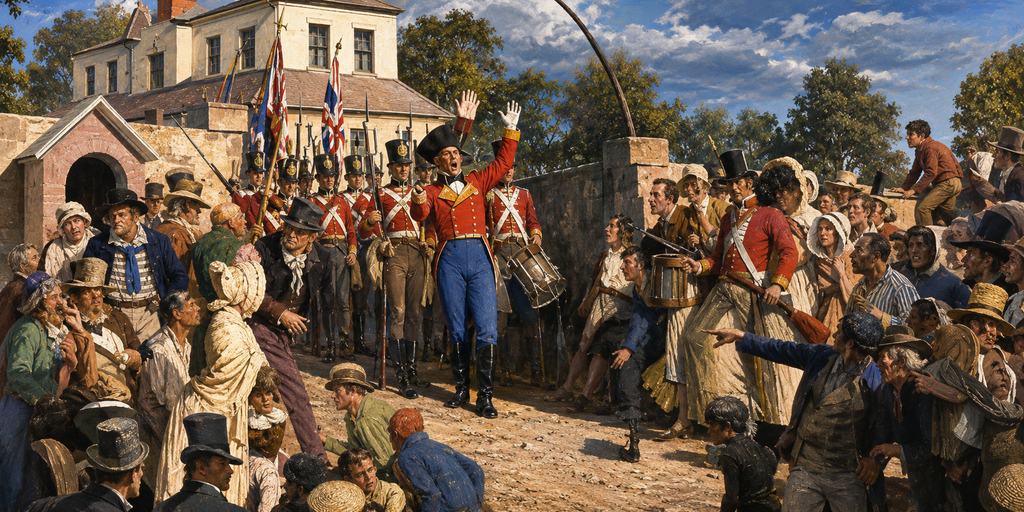
Where’s the Governor?
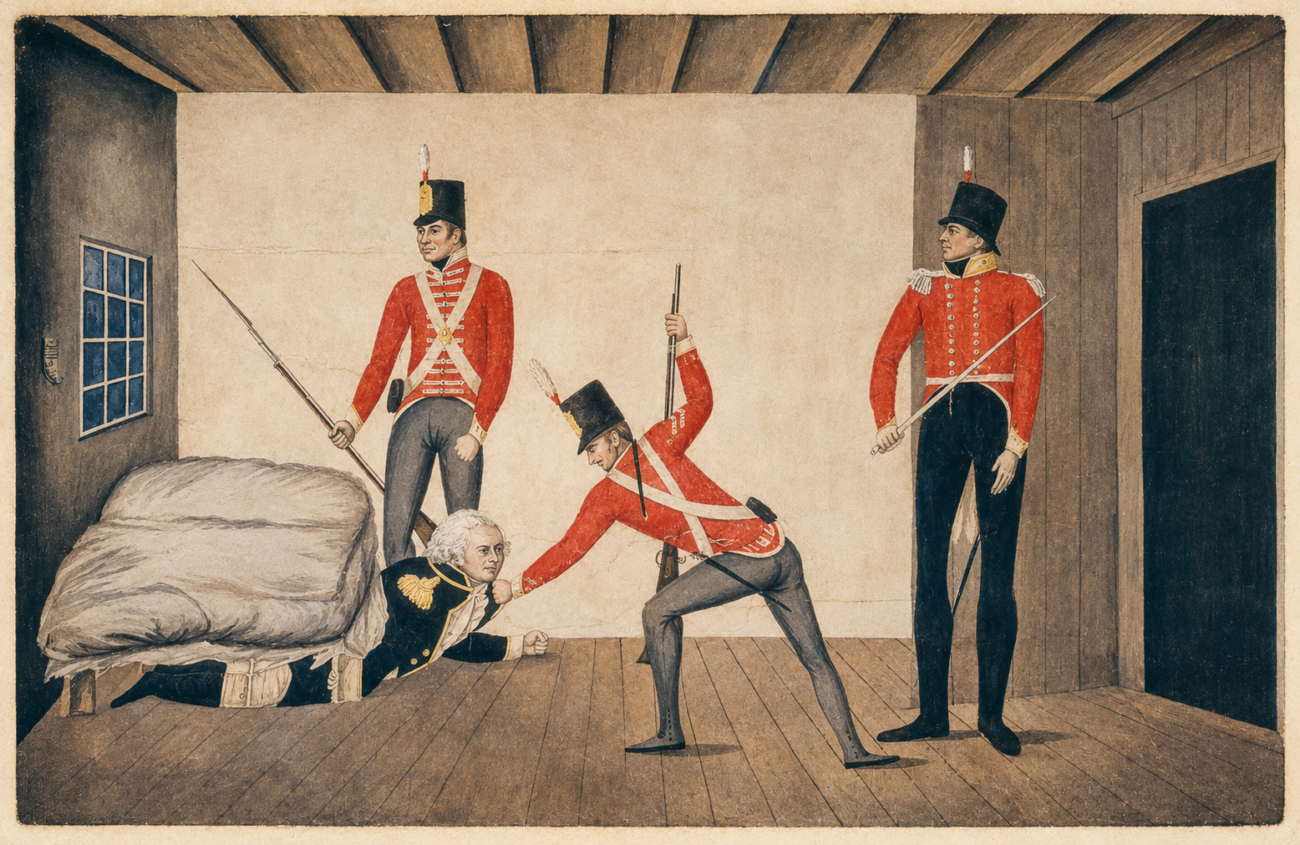
The soldiers entered Government House looking for Bligh. For years afterwards his enemies delighted in claiming that they found him hiding under a bed.
It was a wonderful story. It was also almost certainly a story spread by his enemies to make him look like a coward. Bligh said he had been in another part of the house trying to hide important papers and get away so that he could rally support.
Johnston’s rebellion was more than the arrest of a troublesome governor. Martial law was proclaimed in the colony, including at Parramatta, where Captain Edward Abbott announced it on Johnston’s authority. For a brief period, the military had formally taken control of civil government. Martial law was lifted the following day, 27 January, but Bligh remained under arrest and the rebels continued to govern New South Wales. It had taken the soldiers an afternoon to overthrow the governor. It would take Britain nearly two years to restore proper authority.
Either way, the result was the same. The King’s representative in New South Wales had been arrested by his own soldiers. Major Johnston took control of the colony. And for the next two years, New South Wales was effectively governed by the men who had overthrown its governor. This was not how the British Empire was supposed to work.
The Convict and the Commander
The man who led the rebellion, Major George Johnston, had arrived with the First Fleet in 1788 as an officer of the marines. Also aboard was Esther Abrahams, a young Jewish convict sentenced to seven years’ transportation for stealing twenty-four yards of black silk lace. She had given birth to a daughter in London’s Newgate Prison and brought the baby with her aboard the Lady Penrhyn.
During the voyage, Esther and Johnston began a relationship. Twenty years later, they were still together, with a large family, substantial landholdings and a comfortable home at Annandale. Johnston commanded the New South Wales Corps, while Esther helped manage their growing estate.
Then Johnston overthrew the governor. For a brief period, Esther found herself effectively the colony’s First Lady. Quite a rise for a young woman who had arrived in chains. But Johnston’s triumph was short-lived. He was eventually court-martialled in England and dismissed from the army. Esther managed their estates during his absence, and they formally married in 1814.
Johnston died in 1823. Esther later lost control of her property following legal proceedings brought by her own son. She died in 1846, aged about seventy-nine. From a London prison to the centre of colonial power, Esther had lived a remarkable life. And not an entirely happy one.
The Governor Who Wouldn’t Leave
Bligh spent about a year under arrest. Eventually the rebels agreed to let him board a ship on the promise that he would sail straight back to England. He didn’t.
Instead he sailed to Hobart and waited there, hoping that Britain would restore him as governor. William Bligh was many things. A man who quietly accepted defeat was not one of them.
London Eventually Notices
News travelled slowly in 1808. There was no telephone, telegraph or email to inform London that its distant colony had misplaced its governor. A letter had to travel halfway around the world by ship. Eventually Britain responded.
Johnston was ordered home and court-martialled for his role in the rebellion. He was dismissed from the army in disgrace. Macarthur also went to England. If he returned to New South Wales he faced trial, so he stayed away for about eight years.
Back home, his wife Elizabeth Macarthur ran the family farms and looked after the sheep. She did it remarkably well. Bligh returned to Britain too. Despite his remarkable ability to be present when people mutinied, his naval career continued and he eventually became a vice-admiral.
And Britain sent out a new governor. His name was Lachlan Macquarie. Macquarie took office on 1 January 1810. He brought his own regiment, the 73rd, and instructions to restore lawful government. The New South Wales Corps was sent home.
His arrival effectively ended the Rum Rebellion. It also began another chapter in Australia’s story.
Macquarie would build roads, towns and public buildings, encourage former convicts into respectable society and help transform Sydney from an unruly penal settlement into something beginning to resemble a permanent colony. In a curious way, Australia’s only military coup helped bring about the government that would start building modern Sydney.
Was It Really About Rum?
Not entirely. Rum makes for a much better title than The Complicated Dispute Between Governor Bligh, John Macarthur and the New South Wales Corps Over Trade, Judicial Authority and Colonial Government.
Alcohol certainly mattered. The Corps had benefited enormously from controlling trade, including the trade in spirits. But the rebellion was really about power. Who controlled business? Who controlled the courts? Who controlled the land? And ultimately, who controlled the colony? The answer, for a brief period, was the men with the muskets.
If You Remember One Thing…
Australia did not begin as an orderly little British society gradually developing into the peaceful democracy we know today. Early New South Wales was rough, argumentative and entrepreneurial. Government authority was weak, fortunes were being made, rules were negotiable and London was many months away.
And when Governor Bligh tried to impose his authority, the local establishment simply arrested him.
It is tempting to detect something distinctly Australian in the whole episode: suspicion of authority, powerful personalities, commercial self-interest, an argument over alcohol and a general reluctance to do exactly what someone in Britain had told us to do. Perhaps we shouldn’t push that interpretation too far. But it is difficult to resist.
Fun Fact: You too can walk the path of the Rum Corp
The wonderful thing about the Rum Rebellion is that you can still walk much of the route taken by the soldiers who overthrew Governor Bligh. Start at Wynyard Park, beside Wynyard railway station in the heart of Sydney’s CBD. In 1808, this was the parade ground of the New South Wales Corps, surrounded on three sides by military barracks. The nearby Barrack Street is a reminder of what once stood here.
On the evening of 26 January 1808, around 300 soldiers assembled on this very ground under the command of Major George Johnston. With their regimental colours flying, bayonets fixed and their band playing The British Grenadiers, they set off to arrest the governor.
To follow them, walk east towards George Street, then turn left and head north towards Circular Quay. In 1808, George Street was still called High Street, and it was along this thoroughfare that the soldiers marched, accompanied by hundreds of curious spectators.
At Bridge Street, turn right. The soldiers crossed the Tank Stream, which then ran through this part of Sydney, using a recently repaired stone bridge that gave the street its name. They then marched uphill towards Government House.
Continue along Bridge Street to the corner of Phillip Street, where you will find the Museum of Sydney. This was the site of the original Government House, built for Governor Arthur Phillip in the colony’s earliest years. It was here that Johnston’s soldiers entered the building, searched for Bligh and eventually placed him under arrest.
Today, you can visit the Museum of Sydney and see archaeological remains of the original Government House beneath the modern building. The entire walk from Wynyard Park to the museum takes around fifteen minutes. Not a particularly long march for a regiment of British soldiers. But quite long enough to overthrow the government.
Chapter One: Australian Beginnings: 1788
Chapter Three: The Governor Who Named Everything After Himself