How eleven ships, a collection of convicts and a rather ambitious British government established modern Australia
This is not a traditional history book. It is a collection of stories about Australia, told particularly for people who have come here from somewhere else. And in one sense, that makes it a history of migrants and migrations.
Irish rebels, Chinese gold miners, Afghan cameleers, Ten Pound Poms, Italians, Greeks, Vietnamese refugees and families from India, Lebanon and almost everywhere else. So many groups of people, and so many reasons to board a sailing ship, a steamer or, later, an aircraft.
They came at different times, for different reasons and under very different circumstances. But together they built modern Australia. So we should probably start at the beginning. Or at least our modern beginning.
Why Australia?
In 1788 Britain sent eleven ships halfway around the world to establish a colony at Botany Bay. Together they formed a small, self-contained convoy carrying almost everything needed to build a settlement from scratch: people, food, tools, equipment, seeds and livestock.
On board were around 1,400 people, including roughly 750 convicts, along with marines, sailors, officers, officials, wives and children. It was an extraordinary undertaking, at enormous expense, to start a colony on the far side of the world.
Which raises an obvious question. Why? The traditional answer is criminals.
Britain in the late eighteenth century was changing fast. Its population was growing, towns were expanding and the early Industrial Revolution was beginning to reshape work and society. At the same time, a harsh set of laws later nicknamed the Bloody Code set severe punishments, including death, for a remarkable range of crimes against property. Stealing goods worth a few shillings, roughly a week’s pay for a labourer, could be enough.
For decades Britain had dealt with part of the problem by sending convicted criminals to its American colonies. This was called transportation. It was both a punishment and a way of getting rid of offenders: they were shipped thousands of kilometres away and put to work. Then the American Revolution rather inconveniently removed that option.
Britain’s prisons filled. Old ships known as prison hulks were moored in rivers and packed with prisoners. Australia provided somewhere else to send them. But there was more to it than that. The late eighteenth century was also an age of empires. Britain and France were competing around the world for territory, trade and naval power.
The East India Company had made Britain the dominant power in Bengal and other parts of India, and British trade stretched across the Indian Ocean. European powers were also exploring the islands, trade routes and resources of the Pacific.
James Cook had charted Australia’s east coast in 1770 and claimed it for Britain. French expeditions were exploring the Pacific too. Indeed, within days of the British arriving at Botany Bay in 1788, the French explorer La Pérouse sailed in. The two expeditions were perfectly polite to each other.
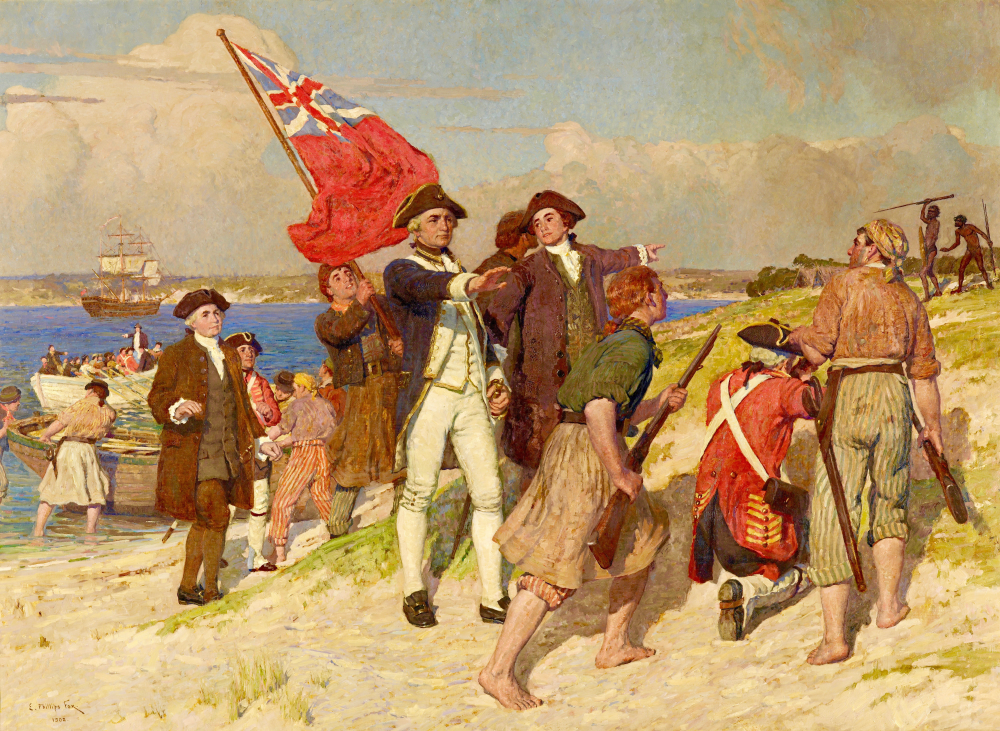
Capitan James Cook’s first landing in Australia, at Botany Bay, 29 April, 1777. By E. Phillips Fox – National Gallery of Victoria
But the message was difficult to miss. If Britain wanted this part of the world, it would be sensible to put some British people in it. Convicts happened to be readily available.
Sydney Cove
When flying into or out of Sydney, you often pass over Botany Bay. Its wide, open waters are surrounded by low-lying land, a container port, industrial sites, highways and a string of suburbs such as Brighton-Le-Sands. It is not quite the spectacular Sydney Harbour that usually makes it onto the postcards.
Yet this rather ordinary-looking stretch of water holds an extraordinary place in Australian history. This was where Cook first came ashore in 1770 and where the First Fleet was originally sent to establish the colony in 1788.
Captain Arthur Phillip, the colony’s first governor, wasn’t particularly impressed with Botany Bay either. The anchorage was poor, the soil disappointing and fresh water hard to find in the low, swampy ground.vIt’s interesting to think that if the water had been slightly better, Sydney might have grown up around Mascot or Brighton-Le-Sands.
Instead, Phillip explored further north and found what he would later describe to Lord Sydney as:
“The finest harbour in the world, in which a thousand sail of the line may ride in the most perfect security.”
Dispatch to Lord Sydney, 15 May 1788. A “sail of the line” was a large warship.
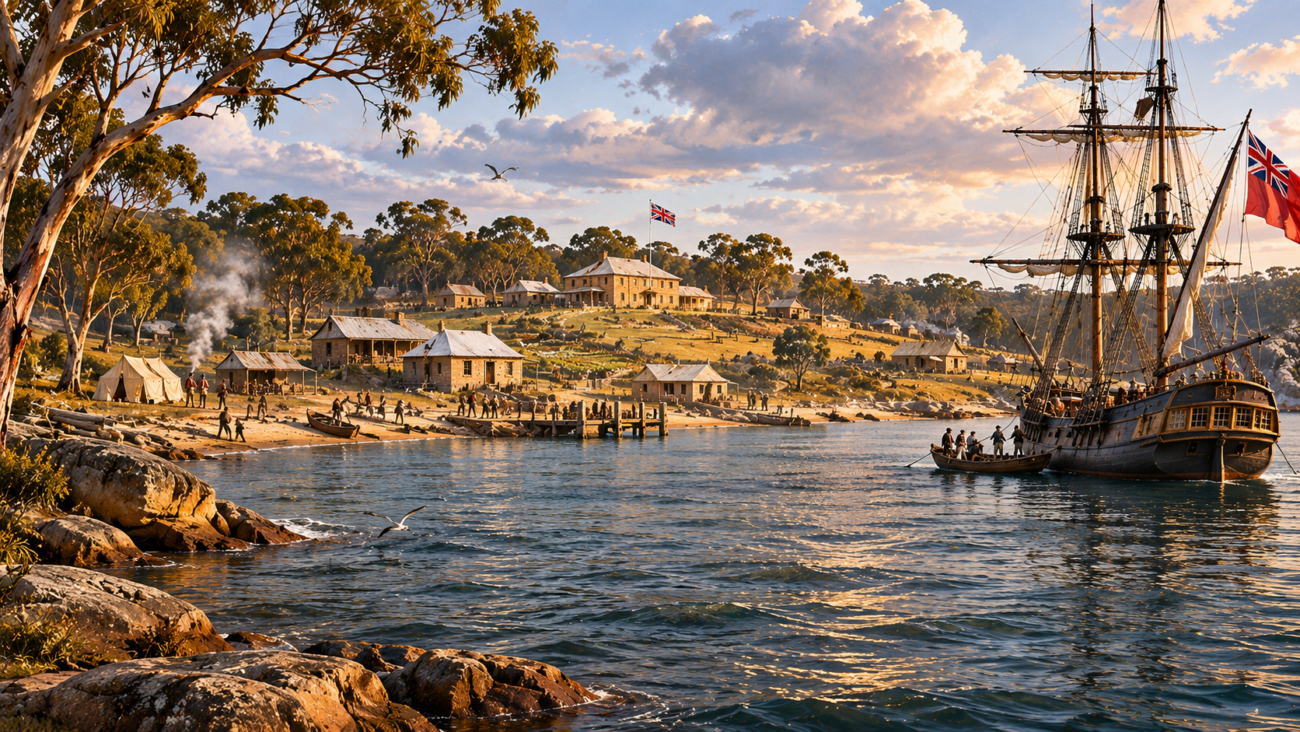
On 26 January 1788, the First Fleet was gathered in Sydney Cove. Imagine for a moment that you are standing aboard one of the ships, looking south towards the head of the cove.
To your right, the land rises steeply into a rocky sandstone ridge before falling towards a narrow strip of flatter ground and a shoreline crusted with oysters. Ahead, the water becomes shallower, giving way to mudflats around the mouth of a small freshwater stream entering the cove from the south-west. To your left, the ground rises more gently towards another low ridge, broken here and there by shelves of exposed sandstone.
There are no buildings. No roads. No wharves. The slopes are covered in eucalyptus woodland, thick in places and more open in others, interrupted by rock and the occasional clearing. And then there is the sound.
Water against the shore. Unfamiliar birds calling through the trees. The creak of timber and rigging. Orders shouted from ship to ship. Anchors dropping into the harbour. After eight months and more than 20,000 kilometres at sea, the British had arrived.

The Founding of Australia by Captain Arthur Phillip RN Sydney Cove January 26th 1788. By Algernon Talmage – State Library of New South Wales
The First Settlement
At first, the settlement clustered around Sydney Cove and the little freshwater stream running into it.
This stream became known as the Tank Stream after convicts cut several large storage tanks into the sandstone during the drought of 1790, when it became clear that the stream could not always be relied upon. And these were not small holes in the ground. Each reportedly held around 20,000 litres of water.
Fun Fact: Sydney’s original water supply is still there.
The Tank Stream survives beneath the modern CBD, mostly confined to drains and tunnels. It follows the shallow valley between George and Pitt Streets, meeting the harbour around Bridge Street. You can see part of the old drainage system through a window in the basement of the General Post Office building at Martin Place. Thousands of people walk through the city every day, mostly unaware that Sydney’s original water supply still runs beneath their feet.
On the eastern side of the Tank Stream, Phillip chose a prominent position overlooking the harbour for Government House. Completed in 1789, it was a modest single-storey brick building, although much more solid than the rough timber and canvas shelters around it.
The site is now occupied by the Museum of Sydney, on the corner of Bridge and Phillip Streets. Remains of the original building survive beneath it. Nearby were government stores and workshops, while across the stream, on the western side of the cove, the marines set up their camp and the convicts built rough huts among the sandstone outcrops.
They called the place The Rocks. The name stuck. Sydney’s oldest neighbourhood is called The Rocks for the remarkably simple reason that it was made up of rocky terraces.
Fun Fact: Some Australian place names are very literal
Australians have a interesting habit of naming places exactly as they are. The Blue Mountains really do look blue from a distance, thanks to a haze given off by the oil in eucalyptus leaves. The Snowy Mountains are mountains that get snowy. And Ninety Mile Beach, as you might guess, is a beach roughly ninety miles long. Sometimes the name even describes something a little more personal. In 1824, explorers Hume and Hovell climbed a mountain hoping to see Port Phillip Bay. The trees blocked the view, so of course they called it Mount Disappointment.
Gardens were cleared, sawpits dug, storehouses built and tracks began appearing between the camps. Within only a few months, the tents and makeshift shelters brought ashore from the ships were beginning to take on the rough outline of a town.
The Girl Who Stole a Bonnet
Among the convicts who stepped ashore in Sydney Cove in 1788 was a fourteen-year-old girl named Elizabeth Hayward. A year earlier, Elizabeth had been an apprentice clog maker in London. She had been convicted of stealing a linen gown, a silk bonnet and a cloak from her employer.
The goods were valued at seven shillings. For this, a thirteen-year-old girl was sentenced to seven years’ transportation to the other side of the world.
Elizabeth sailed aboard the Lady Penrhyn, one of the First Fleet’s convict transports, crowded with more than a hundred women. When she arrived in Sydney, she was fourteen years old. Imagine what that must have been like. A girl barely into her teens, taken from the streets of London, imprisoned, placed aboard a ship for an eight-month voyage and finally brought ashore in a country unlike anything she had ever known.
There were no familiar streets, no family home to return to, and no certainty that she would ever see England again. Elizabeth was assigned as a servant to the household of Reverend Richard Johnson, the colony’s first chaplain.
You might imagine that serving a clergyman would offer some protection from the harsher aspects of convict life. Not necessarily. In February 1789, Elizabeth was sentenced to thirty lashes for being insolent to the Reverend Johnson. She was fifteen.
Elizabeth survived her punishment and went on to live for many years in the colony, eventually becoming a mother. She died in 1836.. The First Fleet is usually remembered for its ships, its officers and the founding of Sydney. But it also carried children like Elizabeth Hayward. A girl who stole a bonnet and was sent halfway around the world, never to see home again.
The First Church Service
On Sunday, 3 February 1788, the Reverend Richard Johnson held the colony’s first Christian service outdoors, beneath a tree. His sermon took as its text: What shall I render unto the Lord for all his benefits toward me? Considering that much of his congregation had just spent eight months aboard a convict ship, some may have regarded the question as open to debate.
Johnson eventually got tired of waiting for the government to build him a church and paid for one himself. It opened in 1793 near today’s Hunter and Castlereagh Streets. Sydney was already developing a familiar habit. When the government failed to provide something, somebody eventually got fed up and did it themselves.
Beyond Sydney
Exploration began almost immediately. The new colony knew surprisingly little about the country beyond Sydney Cove, so naval officers and surveyors began mapping the harbour, following rivers, looking for farmland and trying to understand the enormous landscape around them.
Parramatta, first called Rose Hill, was established in 1788 and quickly became important because its soil was better for farming than the soil around Sydney Cove. Explorers and surveyors pushed along the Hawkesbury and Nepean rivers, while ships charted the coast.
Two young naval men, George Bass and Matthew Flinders, made some of the most important discoveries. In 1798 and 1799 they sailed right around what was then called Van Diemen’s Land, proving that Tasmania was an island.
A few years later, between 1801 and 1803, Flinders sailed right around the whole continent, becoming the first person to do so and mapping much of its coastline along the way. Flinders was also an enthusiastic supporter of calling the continent Australia rather than New Holland, a name that would gradually stick.
In little more than a generation, the blank spaces on European maps were beginning to fill with coastlines, rivers, mountains, towns and names.
Learning to See Australia
As children growing up in Australia, we learn to understand the landscape almost without thinking about it. Shoes left outside are checked for redback spiders. Pool filters are approached carefully in case a funnel-web has moved in. Long grass is best avoided unless you are wearing decent boots.
Bluebottles washed up on the beach are not to be stepped on, even when they look dead. A dark shape moving through the water sometimes leads to a hurried rethink of just how badly you wanted that swim. We learn to look for rip currents, to be wary of falling branches and to recognise the strange stillness that sometimes comes before a summer storm.
For the early colonists, learning to understand the Australian bush was almost as important as mapping it.
Europeans brought ideas formed in Britain and Ireland, where rivers generally flowed reliably, seasons behaved in familiar ways and green country usually meant fertile land. Australia kept proving them wrong.
Rivers shrank into chains of waterholes or disappeared altogether. Huge floods followed droughts. Familiar-looking plants could be useless as food, and country that seemed empty could hide water that an inexperienced traveller walked straight past.
Even the seasons seemed wrong. Trees kept their leaves, Christmas arrived in summer and the hottest winds came from inland rather than from the tropics. It took time simply to learn how to see the place. In fact, it took about a century.
You can watch this happening in Australian art. Early colonial artists often painted the landscape through European eyes, making the bush greener, softer and tidier than it really was. Even the gum tree was a problem. Its pale twisting trunk, sparse uneven canopy and long hanging leaves simply didn’t behave like a respectable European tree.
For decades, Australian landscapes could look faintly English despite being full of supposedly Australian plants. Gradually artists learnt to capture the hard light, enormous skies, grey-green leaves and strange shapes of the bush.
By the time of the Heidelberg School in the 1880s and 1890s, artists such as Tom Roberts, Arthur Streeton and Frederick McCubbin were painting a landscape that was recognisably Australian.
The settlers went through much the same process. Slowly they learnt to read the country: where water might be found, which soils would grow crops, when rivers could be crossed, and which plants, birds and changes in the landscape hinted at what lay ahead.
It was knowledge often gained painfully through trial, error and occasionally disaster. Australia was not simply a new piece of land to occupy. It was a different environment that had to be learnt. And, perhaps more importantly, it took generations before newcomers stopped trying to make it look like somewhere else.
Fun Fact: A different set of feet
When Europeans first reached parts of the Hunter Valley, north of Sydney, in the early 1800s, they found broad grasslands dotted with trees that reminded them of an English park. It seemed almost purpose-made for grazing.
There was one important difference. The kangaroos and wallabies that grazed the landscape had soft, padded feet. The sheep and cattle Europeans brought had hard hooves, which packed down the soil and, combined with heavy grazing and clearing, began to change the landscape.
The settlers thought they had found country perfectly suited to European farming. In reality, they had entered an environment adapted to an entirely different set of feet. Fortunately, they eventually discovered it was also rather good for growing grapes. The Hunter became one of Australia’s oldest and best-known wine regions.
Norfolk Island
Norfolk Island is a tiny island more than 1,400 kilometres east of the Australian mainland. Why start another settlement there almost immediately, when the first one was barely surviving? Global politics again.
Cook had reported that Norfolk Island had tall pine trees and flax plants. Britain was very interested in supplies for its navy. Flax could potentially be made into sailcloth and rope, while the tall pines looked promising for ships’ masts.
There was also the awkward possibility that France might take the island if Britain didn’t. So only weeks after Sydney was founded, Lieutenant Philip Gidley King sailed for Norfolk Island with a tiny party of free men and convicts.
The settlement began with just 23 people and grew to more than a thousand by the early 1790s. The grand plans for naval supplies proved somewhat optimistic. Norfolk Island pine turned out not to be the answer to the Royal Navy’s need for masts. The timber was unsuitable, and the flax scheme never delivered what had been hoped. Both ideas were eventually abandoned.
This would not be the last Australian development project in which early expectations needed some adjustment.
A Very Small Colony
The first few years were all about survival. At times, particularly during the food crisis of 1790, the colony came dangerously close to failing. But somewhere around 1793 the balance began to change.
Sydney grew surprisingly quickly during its first ten years, although it remained a very small town by modern standards. The tents and rough huts gradually gave way to timber houses, workshops, stores and the occasional brick building, while tracks became recognisable streets running back from the harbour.
George Street developed along the western side of the Tank Stream, while the higher ground around The Rocks filled with the homes of convicts and emancipists: former convicts who had finished their sentences or been pardoned and were now free.
On the eastern side, government buildings and the houses of officials spread out from Government House.
Fun Fact: George Street wasn’t always George Street.
Sydney’s main street was originally known informally as High Street, with other names used for different sections. Governor Lachlan Macquarie officially named it George Street in 1810 in honour of King George III.
Beyond Sydney itself, Parramatta became the colony’s main farming centre, farms appeared along the Hawkesbury River and small settlements began linking the harbour to the surrounding countryside.
Perhaps more importantly, a private economy appeared remarkably quickly. Former convicts opened shops and inns. Merchants traded cargoes brought in by visiting ships. Officers built up land and livestock. Alcohol, especially rum, became something to trade as well as drink. In a colony that was always short of coins, it was often used instead of money.
By the late 1790s Sydney had a church, a gaol, a hospital, military barracks, windmills, wharves, warehouses, workshops, shops and a growing number of pubs. It was still a rough little settlement on the edge of the world, dependent on supplies from overseas and surrounded by country Europeans barely knew.
But it was no longer just a collection of tents beside Sydney Cove. A town had begun to emerge.
The City Beneath the City
One of the pleasures of Sydney is that the original settlement is still hiding beneath the modern city.
Sometimes literally. Take Sydney Town Hall.
Thousands of commuters walk past it every day without realising that it was built over Sydney’s first official cemetery. The Old Sydney Burial Ground was used from 1792 until 1820. At least 2,000 people are believed to have been buried there.
When Town Hall was built, efforts were made to remove the graves. They didn’t find all of them. Coffins and tombs turned up in 1904 and 1924 while electric cables were being laid. In 1929, when workers dug the enormous hole for Town Hall railway station, they uncovered tombstones and ironbark coffins.
In 1991, drainage work beneath Town Hall found another seven graves. More turned up in 2003, and again during an archaeological dig beneath the building in 2008. So if Town Hall station occasionally feels haunted, there is at least a historical basis for the suspicion.
The Racecourse in the Middle of the City
Hyde Park is a lovely green space in the heart of the Sydney CBD. It’s home to the Anzac Memorial, the Archibald Fountain, a scattering of statues and some interesting public art. But look at it on a map and you’ll notice it has the long, rounded shape of a racecourse. There is a reason for that.
The land was set aside for public use in the 1790s and became Sydney’s great common, a shared open space for everyone. People grazed animals there, collected firewood and generally used it for whatever seemed sensible at the time. Governor Macquarie officially named it Hyde Park in 1810. Almost immediately, the officers of his regiment set up a horse-racing course there. Sydney’s first official race meeting was held on 15 October 1810.
The course ran around the edges of what is now the park, between Elizabeth, Liverpool and College Streets. The original park was larger than today’s, taking in land now covered by parts of Elizabeth and College Streets.
So Hyde Park doesn’t merely look like an old racecourse. It was one. The first race meeting lasted three days. The colony was barely twenty-two years old and had already organised gambling on horses. Some national traditions establish themselves remarkably quickly.
By 1800
By 1800 the colony of New South Wales was a small British settlement around one of the world’s great harbours. There was a growing farming settlement at Parramatta, farms spreading along the Hawkesbury, and a small outpost on Norfolk Island.
Convicts served their sentences beside the soldiers who were supposed to guard them, while former convicts were beginning to build lives of their own. There were already churches, farms, shops, inns, courts and merchants.
There was also corruption, a great deal of rum, arguments over land, and an increasingly powerful group of military officers who had discovered that being businessmen was much more profitable than simply being soldiers.
Sydney was no longer merely a prison camp. But it wasn’t yet quite a normal colony either. And the question nobody had properly answered was very simple: Who actually ran the place? Eight years later, they were going to find out.
Chapter Two: The Rum Rebellion, A Very Australian Coup